For years, the Cyprus Digital Nomad Visa was capped at a few hundred permits annually — a nice option on paper, effectively closed in practice once the quota filled. That changed in October 2025, when the quota doubled to 1,000 permits, and officials have floated removing the cap entirely in 2026 if demand holds. For remote workers and location-independent founders, this island just became a far more realistic base than it was twelve months ago.
Here is what the visa requires in 2026, what changed, and the tax treatment that makes it worth the paperwork.
What the Visa Is
It lets a non-EU/EEA national live in Cyprus for up to three years while working remotely for a foreign employer or foreign clients — it does not grant the right to work locally. You get an initial one-year residence permit, renewable for up to two further years, for a total of three. It is a residence route for people whose income and clients sit outside the country, not a work permit for the domestic market.
The 2026 Quota Change
The practical barrier was never the requirements — it was the cap. The Cyprus Digital Nomad Visa quota doubled to 1,000 permits in October 2025, a direct response to demand consistently outstripping the old limit. Officials have indicated it could be scrapped altogether in 2026 if applications continue at pace, which would turn a quota-gated option into a straightforwardly available one for anyone who qualifies. If you were previously deterred by stories of the annual allocation filling early, that constraint is now considerably looser than it was.
Requirements and Timeline
The bar is a net monthly income of at least €3,500, verified through recent bank statements or an employment/client contract, plus a modest €70 application fee. Processing typically takes five to seven weeks. Beyond the income threshold, applicants need proof of remote employment or freelance client relationships based abroad, health insurance, and clean criminal record documentation — standard Cyprus residence-permit paperwork rather than anything unusual.
The Tax Treatment That Makes It Worth Doing
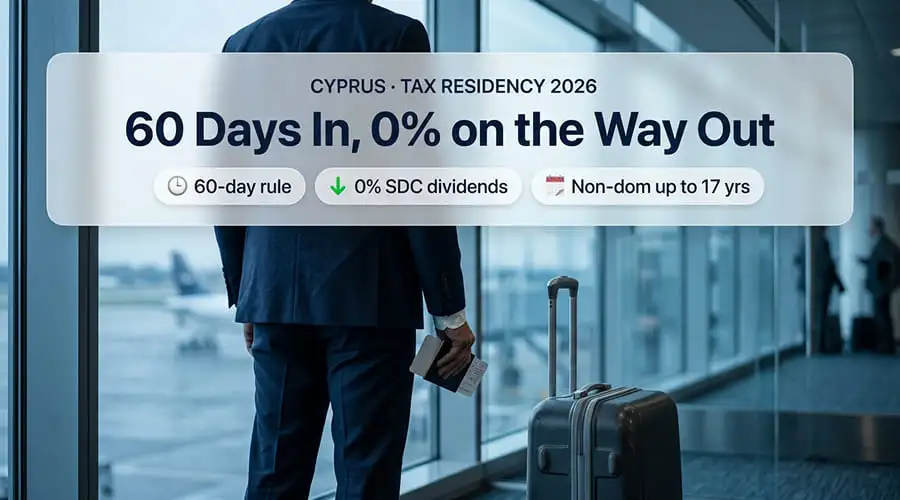
Local tax residency and this visa are separate things, but for many holders they end up going together, and the tax side is where Cyprus earns its reputation. In 2026, the first €22,000 of employment income is tax-free, and where foreign employment income exceeds €55,000, a holder may qualify for a 50% tax exemption running for 17 years. Combined with the country’s already-favourable 60-day tax residency rule and non-dom status, a visa holder who also takes up tax residency can end up with a genuinely light personal tax position — not because the visa itself grants that, but because the two are built to be used together.
Who This Doesn’t Suit
Be clear-eyed about the limits. This route grants no right to work for local clients or employers — if any part of your income shifts to domestic work, you are outside the visa’s terms. It is also not a path to citizenship or a substitute for the old investment-based routes; it is a straightforward remote-work residence permit, nothing more, nothing less. For a founder running a Cyprus company rather than freelancing personally, a proper corporate structure alongside personal tax residency and non-dom planning is usually the more relevant route than this visa on its own.
FAQ
How much income do I need for the Cyprus Digital Nomad Visa?
A net monthly income of at least €3,500, verified through bank statements or an employment/client contract, plus a €70 application fee.
Did the quota change in 2026?
Yes. The annual quota doubled to 1,000 permits in October 2025, and officials have suggested it could be removed entirely in 2026 if demand stays high.
How long does approval take?
Typically five to seven weeks. The initial permit runs one year and is renewable for up to two further years, for a maximum of three years total.
Can I work for local clients on this visa?
No. It is for remote work for foreign employers or clients only — it does not grant the right to work for local clients or employers.
What tax benefits come with residency alongside this visa?
In 2026, the first €22,000 of employment income is tax-free, and foreign employment income above €55,000 may qualify for a 50% exemption for 17 years — separate from the visa itself but commonly used together with tax residency.
Conclusion
Cyprus turned its Digital Nomad Visa from a quota-limited niche option into a genuinely accessible route in 2026 — doubling the cap to 1,000 permits, with talk of removing it altogether. For a remote worker or founder whose income sits outside the country, the requirements are modest (€3,500/month, a small fee, 5–7 weeks), and pairing the visa with local tax residency can mean a very light personal tax bill. It is not a work permit for the domestic market and not a citizenship route — but for what it actually is, Cyprus just made it considerably easier to get.
Considering the Cyprus Digital Nomad Visa, or wondering whether to pair it with tax residency and non-dom status? Send us your income situation and where your clients are based on Telegram or WhatsApp, and we will map out whether the visa, residency, or a company structure — or some combination — actually fits your case.
Setting up a company abroad?
Get a free first consultation on jurisdiction, structure and banking.

This article is for general informational purposes only and is not legal, tax, or financial advice. Consult a qualified professional before acting. Editorial Policy.