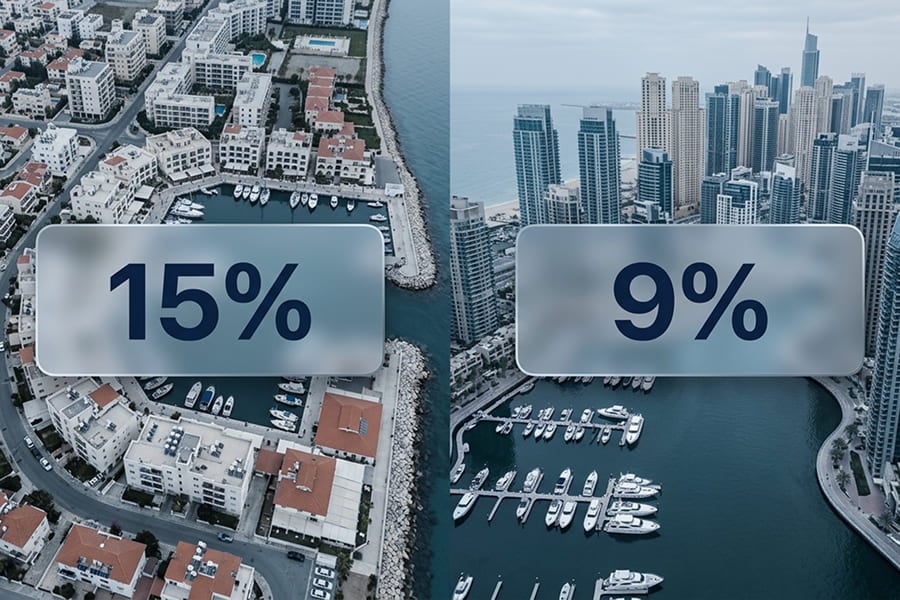
The UAE corporate tax regime that came into force on 1 June 2023 is now in its third year of operation, and the practical reality for foreign-owned companies is clearer than during the rollout. The 9% headline rate is real, but so are the carve-outs — Small Business Relief, the Qualifying Free Zone Person regime, the participation exemption, and the multinational top-up tax that arrived in 2025. This guide explains what a foreign-owned UAE company actually pays in 2026, what it must file, and where the operational traps are.
The Headline Rates
UAE Federal Decree-Law No. 47 of 2022 sets the following structure for Taxable Persons:
| Income band | Rate |
|---|---|
| Taxable income up to AED 375,000 | 0% |
| Taxable income above AED 375,000 | 9% |
| Multinational enterprises within scope of Pillar Two (consolidated revenue ≥ EUR 750M) | 15% top-up (DMTT from 1 January 2025) |
The AED 375,000 threshold is per Taxable Person per tax period, not per group. Holding companies are taxed separately from their subsidiaries unless a tax group is formed.
Small Business Relief: 0% Until AED 3 Million
Small Business Relief (SBR) is the single most useful carve-out for foreign-owned UAE companies in the small-to-mid bracket. A Taxable Person can elect to be treated as having no taxable income — paying 0% — if its gross revenue in the current and all prior tax periods is at or below AED 3,000,000.
Key features:
- SBR applies for tax periods ending 31 December 2026 or earlier (currently confirmed by Cabinet Decision No. 73 of 2023)
- It is an annual election — you choose to apply each year
- The election must be made in the tax return filed within 9 months of period end
- Once revenue exceeds AED 3M in any tax period, SBR is lost permanently
- Members of a multinational group are excluded
For most foreign-owned mainland LLCs and free zone companies under AED 3M revenue, SBR effectively keeps the corporate tax rate at 0% while still complying. You still file the return — you just elect SBR within it.
Free Zone Treatment: QFZP or Not
UAE free zones do not automatically grant 0% corporate tax under the new regime. A free zone company is a Qualifying Free Zone Person (QFZP) — taxed at 0% on Qualifying Income — only if it meets all of:
1. Maintains adequate substance in the free zone (qualifying staff, expenses, assets) 2. Derives Qualifying Income as defined in Cabinet Decision No. 100 of 2023 3. Has not elected to be subject to the standard 9% regime 4. Complies with transfer pricing documentation requirements 5. Maintains audited financial statements 6. Non-qualifying revenue stays under the de minimis threshold (the lower of AED 5M or 5% of total revenue)
Qualifying Income includes transactions with other free zone persons (B2B), specific qualifying activities (manufacturing, logistics, holding shares, fund management, treasury services for group), and qualifying intellectual property income. Income from mainland UAE customers is generally NOT qualifying — that portion is taxed at 9% even if the company is a QFZP.
The single biggest QFZP trap: if non-qualifying revenue exceeds the de minimis threshold in any tax period, QFZP status is lost for that period AND for the following four tax periods. There is no halfway option. Most lean free zone companies serving mixed markets are better off opting out of QFZP and using Small Business Relief instead.
Filing Calendar and Deadlines
The UAE corporate tax compliance year for a typical foreign-owned company looks like this:
| Item | Deadline |
|---|---|
| Corporate tax registration (if not yet done) | Already overdue for most; AED 10,000 late penalty |
| Tax period end (calendar year filers) | 31 December |
| Corporate tax return filing | 9 months after tax period end (e.g. 30 September 2027 for FY2026) |
| Corporate tax payment | Same — 9 months after period end |
| Audited financial statements (if required) | Same deadline as return |
Audit requirements for CT: financial statements must be audited if the company qualifies as a QFZP, OR if revenue exceeds AED 50 million in the tax period. Below those thresholds, audit is optional for CT purposes (though many free zone authorities require audit separately as a licence-renewal condition).
Failure to file the return on time: AED 500 per month for the first 12 months, AED 1,000 per month thereafter. Failure to maintain records: AED 10,000 first instance, AED 20,000 repeat.
Practical Steps for Foreign-Owned Companies
For most foreign-owned UAE LLCs and free zone companies in 2026, the practical sequence is:
1. Register with the Federal Tax Authority through the EmaraTax portal (if not yet done — penalty already applies) 2. Determine whether SBR is available (revenue ≤ AED 3M) and intended to be elected 3. Decide on QFZP status if free zone (often opt out for lean operators serving mixed markets) 4. Implement transfer pricing documentation if connected to related parties — even small companies must have arm’s-length pricing 5. Maintain IFRS-compliant accounting records throughout the year — UAE CT requires accrual accounting 6. File the return within 9 months of period end, even for SBR years (it is not automatic)
A common pattern we see: foreign founders register a free zone company, expect 0% automatically because “free zone,” skip CT registration, and accumulate AED 10,000+ in late penalties before realising the regime applies to them too. If you are a foreign owner planning a UAE company formation in 2026, factor corporate tax registration into your first 90 days post-incorporation — not into year two.
Frequently Asked Questions
Q: I have a Dubai free zone company with no UAE customers — do I owe corporate tax? A: You owe 0% if you qualify as a QFZP (substance, qualifying income, transfer pricing, audit, etc.) or if you elect Small Business Relief (revenue ≤ AED 3M). In both cases you must still register for CT, file the annual return, and maintain the supporting documentation. Doing nothing is not an option.
Q: Does the 9% rate apply to my dividend income from foreign subsidiaries? A: Generally no. The UAE has a participation exemption: dividends and capital gains from qualifying shareholdings (≥5% ownership, held for 12 months, foreign company taxed at ≥9% effective) are exempt from UAE CT. Most foreign operating subsidiaries qualify.
Q: What if I have a freelancer permit, not a company? A: Natural persons conducting business in the UAE are within scope of CT only if their annual turnover from business activities exceeds AED 1,000,000. Below that, no CT obligation. Salary, investment income, and real estate income (in your own name) are also outside CT.
Q: When does the 15% Pillar Two top-up apply to me? A: Only if you are part of a multinational group with consolidated annual revenue of EUR 750 million or more in at least two of the last four years. The UAE Domestic Minimum Top-Up Tax (DMTT) applies from 1 January 2025. Below that revenue threshold, you stay on the 9% (or 0%) regime.
Q: Can I deduct losses from earlier years? A: Yes. Tax losses from tax periods beginning on or after 1 June 2023 can be carried forward indefinitely and offset up to 75% of taxable income in any future period. Losses from before the CT regime are not usable.
Conclusion
UAE corporate tax in 2026 is real, registered, and enforced — but the 9% headline is not what most lean foreign-owned companies actually pay. Small Business Relief keeps the rate at 0% up to AED 3M revenue, the participation exemption protects foreign dividend income, and the QFZP regime (where genuinely applicable) protects qualifying free zone income. The compliance discipline matters more than the rate: register, file, document, and elect.
Setting up or restructuring a UAE company in 2026? Legarithm handles UAE corporate tax registration, free zone setup, and ongoing compliance for foreign-owned operators. See our UAE services.
This article is for general informational purposes only and is not legal, tax, or financial advice. UAE tax law changes — consult a qualified UAE-licensed tax adviser before acting.
Setting up a company abroad?
Get a free first consultation on jurisdiction, structure and banking.

This article is for general informational purposes only and is not legal, tax, or financial advice. Consult a qualified professional before acting. Editorial Policy.