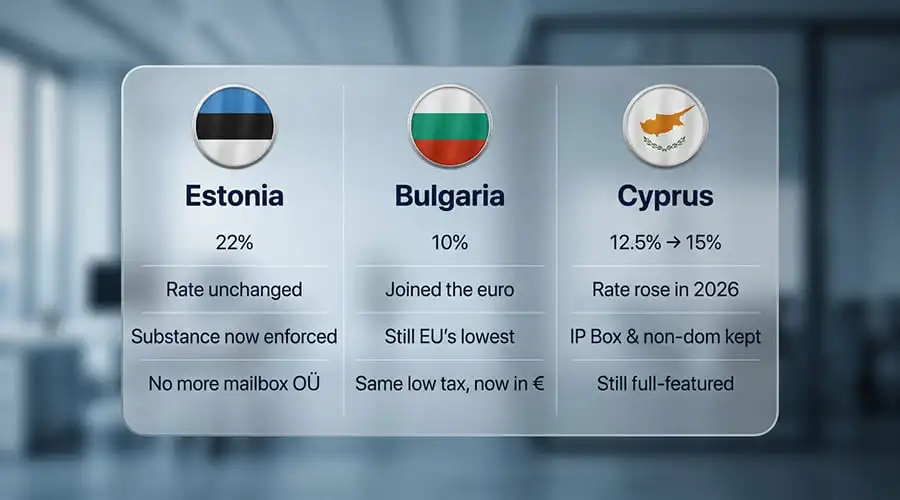
“Cheap” is not the headline tax rate. It is setup cost plus annual maintenance plus the tax you pay when you finally move money to yourself — and each of those three lines can undo a low headline number. This list ranks five EU jurisdictions on the total picture for 2026, including the two that changed this year: Bulgaria, now inside the euro, and Cyprus, now at 15%. Each entry states the capital requirement, the combined tax on distributed profit, and the recurring costs founders forget until the invoice arrives.
1. Bulgaria — €1 Capital, ~15% Combined, Euro Since 2026
Bulgaria is the cheapest serious EU option on almost every line. Minimum share capital is €1, corporate income tax is 10% — the joint-lowest headline rate in the EU alongside Hungary — and dividend withholding tax stayed at 5% for 2026 after a proposed rise to 10% was not adopted. That lands the combined tax on profit you extract at roughly 14.5%, well under the EU average of above 21%.
The change that matters for 2026 is currency. Bulgaria adopted the euro on 1 January 2026 as the 21st euro-area member, at the irrevocably fixed rate of 1.95583 BGN = 1 EUR. For years the lev was the standard objection to a Bulgarian company — a currency you had to hedge and explain to every counterparty. That objection is gone. You now get the EU’s lowest tax bracket in the EU’s common currency, with registration in one to three days. For a founder who plans to draw dividends regularly, Bulgaria is hard to beat.
2. Estonia — €0.01/Share, 0% on Retained Profit, Fully Remote
Estonia wins a different race. Minimum capital is €0.01 per share, incorporation is fully remote through e-Residency, and the corporate tax on retained earnings is genuinely zero — profit you keep inside the company is untaxed for as long as it stays there. Distribution is taxed at the 22/78 rate, and Parliament confirmed that model in December 2025 by cancelling a planned rise to 24%.
The numbers behind Estonia’s appeal are not marketing: e-residents founded 5,556 new companies in 2025, up 15% year on year, delivering roughly €125 million in direct state revenue. For a founder who reinvests profit rather than drawing it — a growing software business, an agency compounding its earnings — Estonia is the cheapest jurisdiction in Europe to run, because the main tax event never happens. The moment you need regular dividends, the calculation flips, and one of the profit-extraction jurisdictions on this list serves you better.
3. Cyprus — 15% CIT, Non-Dom, IP Box, Mandatory Audit
Cyprus is the jurisdiction that got more expensive and more interesting at the same time. Corporate income tax rose to 15% from 1 January 2026, up from 12.5%, to meet the OECD’s global minimum. On headline rate alone, Cyprus fell behind Bulgaria. But the same reform cut the special defence contribution on dividends from 17% to 5% and abolished deemed dividend distribution, which materially improves the position for anyone taking dividends or holding intellectual property.
Cyprus keeps two features that no jurisdiction on this list matches: an IP Box regime delivering an effective rate near 3% on qualifying IP income, and a Non-Domicile regime that shields an individual from tax on dividends and interest for up to 17 years. The cost that offsets this is real and recurring — almost every Cyprus company faces an annual audit, realistically €1,500–3,000 a year (only companies below €300,000 turnover and €500,000 assets can switch to a cheaper review from 2026). Cyprus is not the cheapest to run; it is the cheapest to run for the right income type.
4. Hungary: 9% Headline, the Fine Print
Hungary carries the lowest headline corporate rate in the entire EU at 9%, and for a purely operational business with local activity that number is genuinely attractive. Nevertheless, the headline is where the simplicity ends. Hungary layers a local business tax on top, dividend taxation and social contribution rules complicate profit extraction for non-resident owners, and the administrative environment is heavier than Bulgaria’s flat, predictable regime. The 9% is real; the all-in figure is not 9%.
The honourable mention is any low-tax EU jurisdiction you are tempted to choose on the headline number alone. Ireland’s 12.5% trading rate, for example, comes with a cost base and substance expectations that put it in a different category from Bulgaria or Estonia. The lesson repeats across the list: the lowest advertised rate rarely survives contact with the full invoice.
The Hidden Recurring Costs Most Lists Ignore
Every ranking that stops at the tax rate is incomplete, because the recurring costs are where jurisdictions genuinely diverge. Three lines decide the real annual bill. Audit: mandatory in Cyprus at €1,500–3,000, far lighter or absent for smaller companies in Bulgaria and Estonia. Accounting: every EU company needs bookkeeping and annual filings, and the price scales with transaction volume and VAT complexity, not with the headline tax rate. Substance: with the EU folding ATAD3’s anti-shell principles into the Directive on Administrative Cooperation and jurisdictions like Estonia tightening vetting, a credible presence — not just a registered address — is increasingly a cost line rather than an optional extra.
Add banking to the picture. Opening an operating account for a new EU company now takes weeks and detailed questions, and in some jurisdiction-and-business combinations it is the hardest part of the whole setup. A €1 company you cannot bank is not a bargain. To sum up the real ranking: cheapest to open is Bulgaria and Estonia; cheapest to run depends entirely on whether you reinvest or extract, and on whether your income is trading, IP, or passive.
FAQ
What is the single cheapest EU country to register a company in for 2026?
Bulgaria, on the combined picture: €1 minimum capital, 10% corporate tax, 5% dividend withholding tax, registration in one to three days, and the euro since 1 January 2026. Estonia matches it for founders who reinvest rather than distribute.
Is Bulgaria still cheap now that it uses the euro?
Yes — the euro changed the currency, not the tax. Corporate tax stays at 10% and dividend withholding at 5%; the fixed conversion rate was 1.95583 BGN = 1 EUR. If anything, joining the euro removed the currency risk that used to count against Bulgaria.
Why is Cyprus on a “cheapest” list if it is now 15%?
Because “cheapest” depends on income type. Cyprus is more expensive on corporate rate and carries a mandatory audit, but its 5% SDC on dividends, non-dom regime, and roughly 3% effective IP Box rate make it the lowest-cost option for IP income and for individuals taking large dividends.
Does Estonia really cost almost nothing to run?
For a reinvesting business, close to it — retained profit is taxed at 0% and minimum capital is €0.01 per share. The cost appears only when you distribute profit, taxed at 22/78, and in ordinary accounting and filing fees.
What recurring cost do founders most often forget?
The mandatory annual audit in Cyprus, and substance costs generally. A jurisdiction can be cheap to register and expensive to keep compliant — the audit line and a credible local presence are where that gap opens up.
Conclusion
The cheapest EU company in 2026 is not the one with the lowest tax rate on the brochure — it is the one whose setup cost, recurring audit and accounting, and tax-on-extraction add up to the smallest total for the way you actually operate. Bulgaria wins for low-cost profit extraction in the euro, Estonia for reinvestment, Cyprus for IP and non-dom income despite its higher rate. The right answer is the one that matches your cash flow, not the one with the smallest headline number.
Send us your model and we will give you an all-in first-year cost estimate for your chosen jurisdiction — setup, audit, accounting, and the real tax on the profit you plan to take out. Message us on Telegram or WhatsApp for the full figure before you commit.
Setting up a company abroad?
Get a free first consultation on jurisdiction, structure and banking.

This article is for general informational purposes only and is not legal, tax, or financial advice. Consult a qualified professional before acting. Editorial Policy.