Founders often pick a jurisdiction on a single number — the headline tax rate — and discover the real costs later. That number tells you almost nothing about what an EU company will actually cost to run, or whether it fits the way you move money. This guide walks through the seven checks that decide whether an EU company works for your model in 2026: the true combined tax on profit you extract, capital and substance rules, audit obligations, banking reality, and the residency tests that changed this year. Read it before you file, not after.
1. The Combined Tax Rate, Not the Headline Rate
The headline corporate tax rate is the figure every jurisdiction advertises, and it is the least useful number in the comparison. What you actually pay is corporate tax on profit plus the tax you incur when you move that profit to yourself as a dividend. Run the three flagship jurisdictions side by side and the ranking shifts.
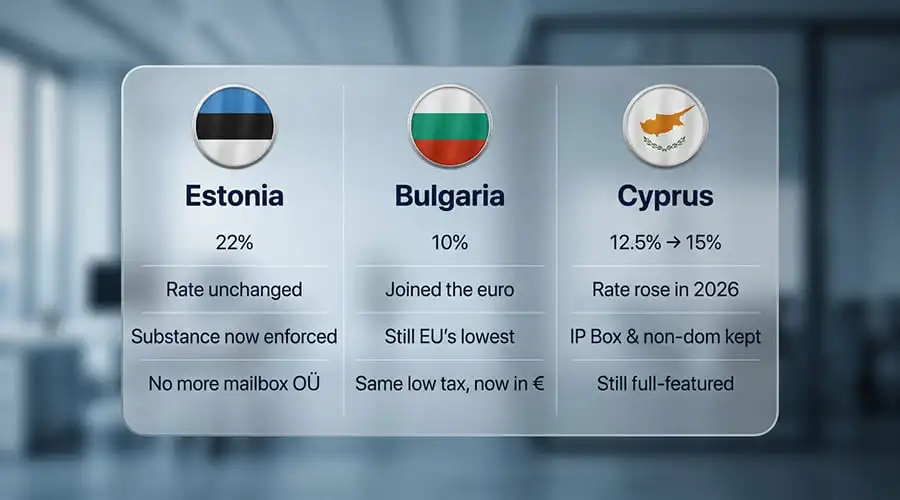
Bulgaria charges 10% corporate income tax and a 5% withholding tax on dividends, which lands at roughly 14.5% combined on profit you extract. Cyprus raised its corporate rate to 15% from 1 January 2026, up from 12.5%, but its dividend picture is more nuanced once you factor in the special defence contribution and non-dom status. Estonia charges nothing on retained profit and taxes distribution at the 22/78 rate — about 22% of the net amount you pay out. The headline numbers say Bulgaria 10%, Cyprus 15%, Estonia “0%”. The real numbers say something entirely different, and you cannot plan around the wrong one.
2. When the Tax Triggers Profit
The Estonian model deserves its own check because it changes the whole logic of when money is due. In most EU jurisdictions, corporate tax attaches to profit when it is earned. In Estonia, tax attaches only when profit leaves the company as a dividend. Retained earnings — profit you keep and reinvest — carry a 0% rate for as long as they stay inside the company.
This is not a loophole; it is the deliberate design of the Estonian corporate tax system, and Parliament confirmed it in December 2025 when it cancelled a planned rise of the distribution rate to 24%. The 22/78 model held. For a founder who reinvests everything, the trigger point never arrives and the effective rate stays at zero. For a founder who needs regular income from the company, the trigger arrives every time a dividend is paid, and the rate is squarely in normal European territory. The question is not “what is the rate” but “when does it fire” — and the answer depends entirely on your cash-flow habits.
3. Substance and Residency Tests You Now Have to Pass
A registered address is no longer a business. Two of the three flagship jurisdictions tightened their residency and substance expectations for 2026, and the trend across the EU is one direction only.
Cyprus added an incorporation-based tax-residency test from 1 January 2026: any company incorporated under Cyprus law is now treated as Cyprus tax-resident, alongside the older management-and-control test. That pulls every Cyprus-registered company into the tax net rather than leaving residency to be argued case by case.
Estonia, meanwhile, tightened e-Residency vetting — the Police and Border Guard Board now declines applications where the business rationale is unclear or the activity code does not match the stated model. At the EU level, the standalone ATAD3 “Unshell” Directive was formally dropped on 20 June 2025, but its substance principles are being folded into the Directive on Administrative Cooperation, so the pressure to show a real business did not disappear — it changed address. Plan for substance you can evidence, not substance you can claim.
4. Minimum Share Capital, Audit Obligations, and Setup Timelines
The last check is the one that shows up on the invoice. Setup cost, minimum capital, and the recurring audit line vary widely, and the cheap-to-open jurisdiction is not always the cheap-to-run one.
Bulgaria requires as little as €1 in share capital and registers a company in roughly one to three days. Estonia sets minimum capital at €0.01 per share and completes incorporation, fully remotely, in the same one-to-three-day window. Cyprus is the outlier on recurring cost: almost every Cyprus company faces an annual audit, which realistically runs €1,500–3,000 a year; only companies below €300,000 turnover and €500,000 assets can switch to a cheaper review from 2026.
That audit is not a penalty — it is a structural feature that makes Cyprus more expensive to maintain than its headline rate suggests, and it is exactly the kind of cost founders discover in month twelve rather than month one. Add banking to the picture: opening an account for a newly formed EU company takes longer and asks harder questions than it did five years ago, and a jurisdiction you can register in a day is worthless if you cannot bank it in a quarter.
FAQ
Which EU country is genuinely cheapest to register a company in for 2026?
On setup and maintenance combined, Bulgaria and Estonia lead: €1 and €0.01-per-share minimum capital respectively, one-to-three-day registration, and no mandatory audit for smaller companies. Cyprus is cheap to register but carries a mandatory annual audit of roughly €1,500–3,000.
Is Estonia really 0% corporate tax?
Only on retained earnings. The moment you distribute profit as a dividend, Estonia taxes it at 22/78 — about 22% of the net amount paid out. Reinvested profit is genuinely untaxed; extracted profit is not.
Now that Cyprus is 15%, is it still worth registering there?
It depends on your income type. The corporate rate rose to 15% on 1 January 2026, but Cyprus simultaneously cut the special defence contribution on dividends from 17% to 5% and abolished deemed dividend distribution, which strengthens its case for IP and passive income and for non-dom individuals.
Do I need a real office and staff in these jurisdictions?
Increasingly, yes — or at least evidenceable substance. Cyprus’s new incorporation test, Estonia’s tighter e-Residency vetting, and the migration of ATAD3 substance rules into the DAC framework all point the same way. A registered address alone is a risk, not a structure.
How long does it take to register an EU company in 2026?
Incorporation itself is fast — one to three days in Bulgaria and Estonia. Banking is the real timeline; opening an operating account can take weeks and now involves detailed questions about your business model and beneficial ownership.
Conclusion
The number on the brochure is the wrong number. What decides whether an EU company works for you in 2026 is the combined tax on the profit you actually take out, the point at which that tax triggers, the substance you can prove, and the recurring costs — audit and banking — that never make the headline comparison. Bulgaria, Estonia, and Cyprus each win for a different founder, and the only way to know which one wins for you is to run your own numbers through all seven checks before you file.
Tell us your model — how you earn, how often you take profit out, and where you are resident — and we will size the real cost for you before you commit to a jurisdiction. Message us on Telegram or WhatsApp and we will run the seven checks against your actual situation.
Setting up a company abroad?
Get a free first consultation on jurisdiction, structure and banking.

This article is for general informational purposes only and is not legal, tax, or financial advice. Consult a qualified professional before acting. Editorial Policy.