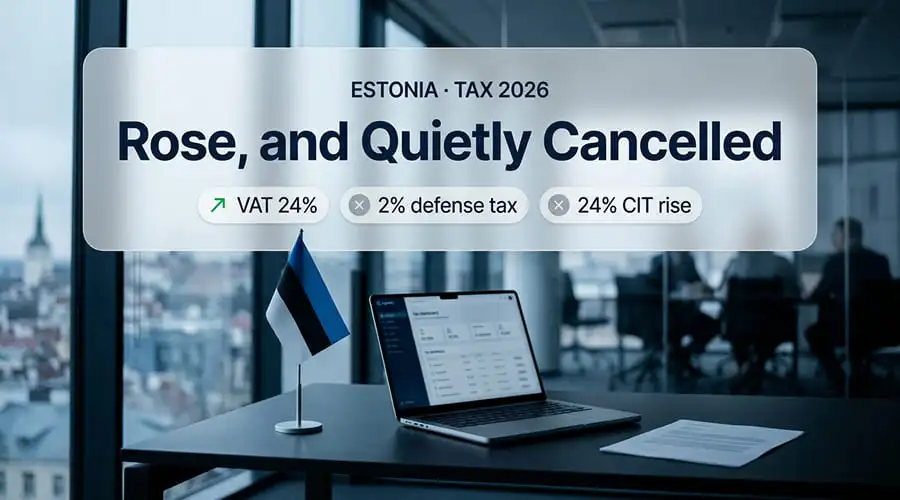
“Estonia has 0% corporate tax” is one of the most repeated lines in the offshore corner of the internet — and it is half true, that’s why should be trated carefully. Reinvested profit genuinely is untaxed. But the day you pay yourself a dividend, Estonia taxes it at 22/78 — roughly 22% of the net amount you take. Founders who plan around “0%” get an unpleasant surprise at the moment they want their money. Here is what the number really is, where the myth comes from, and when it quietly becomes true.
Where the “0%” Comes From — the Retained-Earnings Rule
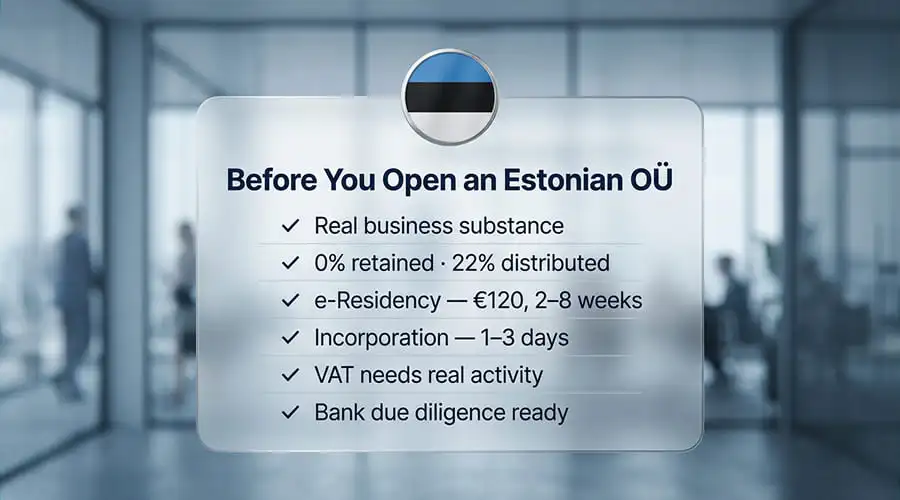
The myth has a real foundation. Estonia genuinely doesn’t tax retained earnings. Profit that stays inside the company — reinvested into hiring, product, inventory, or simply held — carries a 0% corporate income tax rate for as long as it remains undistributed. There is no annual tax on accumulated profit the way most European systems impose. On this narrow point, the internet is correct.
This is deliberate design, not an accident or a loophole, and Parliament reaffirmed it in December 2025 by cancelling a planned rise of the distribution tax to 24%. The 22/78 model held, and with it the 0%-on-retained rule. So when someone says “Estonia is 0% tax,” they are describing something true — but only about half of the tax system, and specifically the half that applies while your money is still the company’s money. The trouble begins the moment you want it to be your money instead.
What Happens When You Distribute — the 22/78 Arithmetic in Plain Numbers
When an Estonian OÜ distributes profit as a dividend, it pays corporate income tax at the 22/78 rate. The name describes the maths: for every €78 that reaches the shareholder, €22 goes to the state — which is 22 divided by 78, or about 28.2% of the net dividend, and 22% of the gross pre-tax amount.
Put concrete numbers on it. Say the company has €100,000 of profit it wants to distribute in full. It pays roughly €22,000 in tax and the shareholder receives about €78,000. That is not 0%. It is a normal European effective rate on distributed profit, landing right alongside the combined rates of jurisdictions that never claimed to be “0%” in the first place. The Estonian advantage was never a lower rate on money you take out — it was the ability to delay the rate entirely by not taking the money out. Confuse the two and you build a plan on a number that does not exist.
How Estonia Compares Once You Extract Profit
Line Estonia up against the jurisdictions it is usually pitched against, and measure at the point of extraction rather than the point of earning, and the ranking looks very different from the “0%” fantasy. Bulgaria charges 10% corporate income tax plus a 5% dividend withholding tax, landing at roughly 14.5% combined on profit you extract — comfortably below Estonia’s 22/78 for a founder distributing in the year the profit is earned. Against the wider EU, where the average headline corporate rate sits above 21%, Estonia’s distributed rate is unremarkable; it is the deferral, not the rate, that stands out.
Cyprus adds another angle. Its corporate rate rose to 15% in 2026, but a non-domiciled individual is exempt from the special defence contribution on dividends for up to 17 years, which can push the personal extraction cost well below Estonia’s for the right founder. The honest comparison is this: if you extract profit promptly, Estonia is one of the more expensive options among the low-tax jurisdictions, not the cheapest. The “0%” myth inverts reality — it markets Estonia as the cheapest place to take money out when it is actually one of the more expensive, and the cheapest place to leave money in.
When “0%” Is Genuinely the Right Strategy — the Reinvestment Horizon
None of this means the myth is useless — it means it is mislabelled. There is a real strategy hiding inside it, and for the right founder it is genuinely powerful. If you do not need to extract profit, Estonia’s 0%-on-retained rule lets your capital compound untaxed year after year. A business reinvesting everything into growth, a holding vehicle accumulating for a future acquisition, a founder content to let value build inside the company and realise it later — for each of these, the effective rate really is zero, for as long as the reinvestment horizon lasts.
The key variable is time. The longer you defer distribution, the more the deferral is worth, because you are compounding on money that would otherwise have been taxed away. A founder who reinvests for a decade and distributes once at the end has extracted enormous value from the 22/78 model. A founder who distributes every year has extracted none of it and simply paid a normal rate on a delay. To sum up: “0% Estonia” is not a lie, but it is a strategy, not a rate — and it only pays off if reinvestment, not income, is what you actually want.
FAQ
Is it true that Estonia has 0% corporate tax?
Only on retained earnings. Profit kept inside the company is untaxed, but distributed profit is taxed at 22/78 — about 22% of the net amount paid out. The “0%” applies to money you leave in, not money you take out.
What does 22/78 actually mean in percentages?
For every €78 the shareholder receives, €22 goes to the state. That is roughly 28.2% of the net dividend and 22% of the gross pre-tax profit. On €100,000 distributed, about €22,000 is tax and €78,000 reaches you.
Is Estonia cheaper than Bulgaria if I take dividends?
Usually not. Bulgaria’s 10% corporate tax plus 5% dividend withholding lands at roughly 14.5% combined on extracted profit, below Estonia’s 22/78 for a founder distributing in the year of earning. Estonia wins on reinvestment, not extraction.
Did Estonia’s distribution tax go up in 2026?
No. A planned rise to 24% was cancelled by Parliament in December 2025. The rate on distributed profit stays at 22/78, and retained earnings remain untaxed.
So when is Estonia actually the cheapest option?
When you reinvest rather than distribute. The longer you defer taking profit out, the more the 0%-on-retained rule is worth, because your capital compounds untaxed. For a business that leaves profit in for years, the effective rate genuinely is zero.
Conclusion
The “0% Estonia” is a half-truth wearing the costume of a whole one. Retained profit is untaxed; distributed profit is taxed at 22/78, a perfectly ordinary European rate. The mistake is planning your income around a rate that only exists while you leave the money alone. Understood correctly, Estonia is not the cheapest place to take profit out — it is the best place to keep profit in and let it grow untouched. Match the tool to your intention and the myth resolves into a genuinely useful strategy.
Want the real effective rate for your actual plan: reinvestment horizon, distribution schedule, and all? Tell us how and when you intend to take profit out, and we will calculate what an Estonian OÜ would really cost you, next to the alternatives. Contact Legarithm for deeper expertise👇
Setting up a company abroad?
Get a free first consultation on jurisdiction, structure and banking.

This article is for general informational purposes only and is not legal, tax, or financial advice. Consult a qualified professional before acting. Editorial Policy.