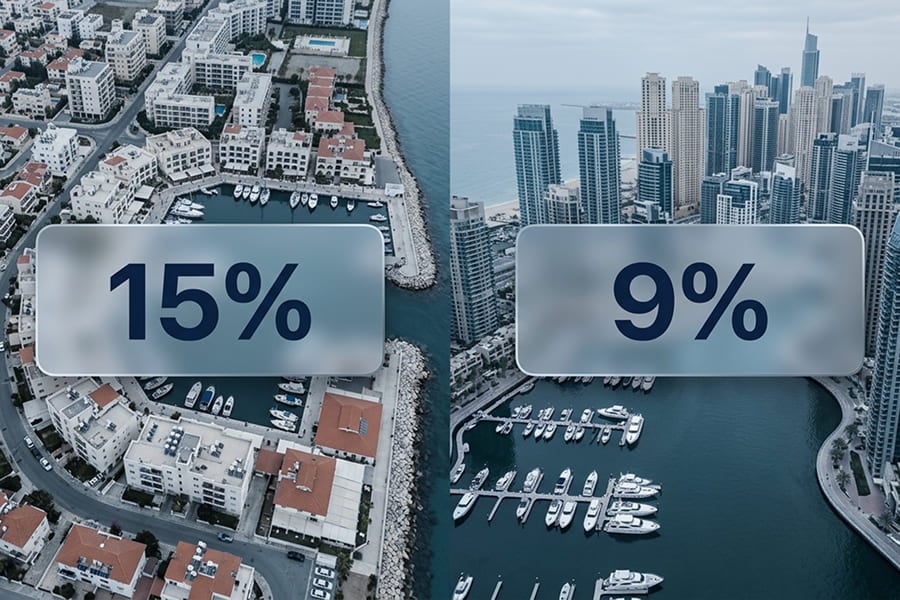
Cyprus remains one of the most practical EU jurisdictions for international entrepreneurs, holding structures, and founders who want a EU-regulated base with a competitive tax framework. In 2026, that framework shifted: Cyprus raised its corporate tax rate from 12.5% to 15% flat, effective 1 January 2026, aligning with the OECD Pillar Two global minimum. The fundamentals that make Cyprus attractive — EU membership, 65+ double tax treaties, a genuine non-dom regime, zero withholding tax on outbound dividends — remain intact.
This guide covers exactly what you need to form a Cyprus private limited company (Ιδιωτική Εταιρεία Περιορισμένης Ευθύνης): the legal requirements, documents to prepare, the step-by-step process from name approval to incorporation certificate, and your ongoing obligations once the company is live.
If you want to understand the full Cyprus corporate tax picture before committing, see our Cyprus services overview.
Requirements to Form a Cyprus Company
Cyprus companies are governed by the Companies Law, Cap. 113 — an English common law framework carried over from British administration. The requirements are straightforward and permit 100% non-resident ownership with no local equity requirements.
Directors
A Cyprus private limited company requires a minimum of one director. Directors can be natural persons or corporate entities, and they can be resident or non-resident in Cyprus.
That said, director residency has practical tax implications. For a company to be treated as Cyprus tax resident — and therefore benefit from Cyprus’s corporate tax rate and treaty network — management and control must be exercised in Cyprus. In practice, this means the majority of directors should be Cyprus-resident individuals or a Cyprus-based corporate director. If all directors sit outside Cyprus, the company risks being treated as a tax resident of another jurisdiction. Most clients either appoint a local nominee director or use a Cyprus formation service that includes a resident director arrangement.
Shareholders
A minimum of one shareholder is required. There is no maximum. Shareholders can be individuals or corporate entities of any nationality — Cyprus imposes no restriction on foreign ownership. A single foreign individual can hold 100% of shares.
Shareholders are listed on the public register at the Cyprus Registrar of Companies (RoC). If privacy is a concern, nominee shareholder arrangements (backed by a declaration of trust) are legally available and commonly used.
Company Secretary
Cyprus law makes the appointment of a company secretary mandatory — this is a requirement that distinguishes Cyprus from many other EU jurisdictions. The secretary is responsible for maintaining statutory registers, filing annual returns, and ensuring the company meets its legal formalities. The secretary cannot be the same person as the sole director. Most formation providers supply a company secretary as part of the incorporation package.
Registered Office
Every Cyprus company must maintain a physical registered office address in Cyprus. This is the address used for official correspondence from the Registrar of Companies and Tax Department. A P.O. box does not qualify. Formation agents and law firms routinely offer registered office services as a standalone add-on.
Share Capital
There is no statutory minimum share capital for a Cyprus private limited company. Technically €1 is sufficient. In practice, €1,000 is the customary amount — it signals a credible corporate structure to banks and counterparties. Share capital can be denominated in any currency and increased at any time by shareholder resolution.
The annual company levy of €350 that used to apply to all Cyprus companies was abolished from 2024. It is no longer a cost to factor in.
Documents Required for Cyprus Company Formation
KYC (Know Your Customer) compliance is mandatory under Cyprus AML legislation and must be completed before or alongside the incorporation filing. The standard document set for each beneficial owner, director, and shareholder includes:
- Passport or national ID — certified copy (notarised or apostilled, depending on country of issue)
- Proof of residential address — utility bill or bank statement, dated within the last three months, in the individual’s name
- Source of funds / source of wealth declaration — a brief written statement, with supporting evidence where applicable (bank statements, company accounts, sale agreements)
- CV or professional profile — some registered agents require this for higher-risk profiles or complex structures
- Company name preferences — at least two or three options in order of preference; the Registrar approves names based on availability and non-conflict with existing names
For corporate shareholders (where the shareholder is itself a company), the documentation expands to include the corporate shareholder’s certificate of incorporation, memorandum and articles of association, register of directors and shareholders, and good standing certificate — all typically apostilled.
Preparing these documents before instructing a formation agent meaningfully compresses the timeline.
Step-by-Step Cyprus Company Formation Timeline
The entire process from instruction to incorporation certificate typically takes 5–10 working days. Here is how that breaks down.
Step 1: Name Approval (1–3 working days)
The proposed company name is submitted to the Cyprus Registrar of Companies for approval. The RoC checks for conflicts with existing registered names and reserved words. Names must be in Latin script (or Greek) and cannot imply government affiliation or regulated activity without appropriate authorisation. Approval typically comes back within one to three working days; having backup names ready avoids delays if the first choice is rejected.
Step 2: Drafting the Memorandum and Articles of Association (2–4 days, overlapping)
Once the name is approved, the formation agent or lawyer drafts the Memorandum and Articles of Association (M&AA) — the constitutional document that defines the company’s objects, share structure, and internal governance rules. Standard M&AA templates are used for most trading and holding companies; bespoke clauses are added for specific structures. This work often runs in parallel with KYC review.
Step 3: KYC and Due Diligence (parallel)
Your formation agent or law firm conducts AML due diligence on all beneficial owners, directors, and shareholders. This runs concurrently with name approval and M&AA drafting. Delays here are almost always caused by incomplete or non-apostilled documents — submit clean documentation upfront.
Step 4: Filing with the Registrar of Companies (5–10 working days)
The signed M&AA and supporting formation documents (HE1, HE2, HE3 forms) are filed with the Cyprus RoC. The RoC processes the application and, if everything is in order, issues the incorporation. Official processing times are 5–10 working days, though expedited processing (for a fee) can reduce this to 1–2 days via the RoC’s fast-track service.
Step 5: Certificate of Incorporation and Statutory Documents
Once incorporated, you receive the Certificate of Incorporation plus a full company kit: Certificate of Shareholders, Certificate of Directors and Secretary, Certificate of Registered Office, and the stamped M&AA. These are the documents you will need for bank account opening, tax registration, and entering into contracts.
Step 6: Tax Registration, VAT, and Employer Registration
Immediately after incorporation:
- Tax Identification Number (TIC) — register the company with the Cyprus Tax Department. Required before filing any tax return or paying corporate tax.
- VAT registration — mandatory if annual taxable turnover exceeds €15,600. Voluntary registration is available below this threshold. Cyprus standard VAT rate is 19%; a reduced 9% rate applies to hospitality and pharma. Our team handles Cyprus VAT registration and compliance as a standalone service.
- Employer registration — required if you hire employees in Cyprus. This triggers GESY (health levy) obligations: 2.65% employee / 2.90% employer, capped on salary up to €180,000. See our Cyprus payroll service for ongoing payroll administration.
Step 7: Bank Account Opening (2–4 weeks, parallel)
Bank account opening in Cyprus runs in parallel with post-incorporation registrations but takes longer — typically two to four weeks for major Cyprus banks (Bank of Cyprus, Eurobank, Hellenic Bank) depending on the bank’s own due diligence. EMI accounts (e.g., Wise Business, Revolut Business) can be activated faster for initial operational needs. We assist with Cyprus bank account opening and can recommend the right institution based on your business profile.
Can Non-Residents Form a Cyprus Company?
Yes — fully. Cyprus imposes no residency requirement on directors or shareholders. A single non-resident individual can own 100% of a Cyprus company and serve as its sole director without ever visiting the island.
Formation is handled remotely via a Power of Attorney (PoA) granted to your formation agent or lawyer in Cyprus. You sign the PoA in your home country (apostille required for most non-EU countries), and the agent signs the M&AA and RoC forms on your behalf. No visit to Cyprus is required for the incorporation itself.
The residency question becomes relevant for tax purposes, not for legal formation. If you want the company to be Cyprus tax resident — and access the 15% corporate tax rate, the IP Box regime, and Cyprus’s treaty network — management and control must demonstrably sit in Cyprus. Non-residents who want these benefits typically appoint a Cyprus-resident director, establish substance (an office, regular board meetings in Cyprus), or relocate personally under the 60-day non-dom rule: spend at least 60 days per year in Cyprus, no more than 183 days in any single other country, a business, job or directorship in Cyprus, and a permanent home there (since 1 January 2026 you no longer need to have no tax residency elsewhere). This qualifies you as a Cyprus tax resident eligible for non-dom status and its 17-year SDC exemption on dividends and interest.
We provide full Cyprus non-dom status advisory alongside company formation for founders considering relocation.
Annual Obligations After Incorporation
Incorporating is the start, not the end. Cyprus has clear ongoing compliance requirements — factor these into your cost model.
- Statutory audit — the default for every Cyprus company, stricter than most EU member states where small companies are audit-exempt. The exception is the small-company review: for financial years beginning on or after 6 February 2026, a company with net turnover below €300,000 and total assets below €500,000 for two consecutive years can opt for a lighter review engagement (ISRE 2400) by a licensed auditor instead. Our Cyprus accounting services team coordinates with licensed local auditors.
- Annual return (HE32) — filed with the RoC each year, confirming current directors, shareholders, registered office, and share capital.
- Corporate tax return — due annually; provisional tax payments in July and December each year. Corporate tax rate: 15% (the previous 12.5% rate expired on 31 December 2025). Loss carry-forward period is now 7 years, extended from 5 under the 2026 reform.
- VAT returns — quarterly for most registered businesses. Cyprus VAT is administered by the Tax Department.
- VIES / MOSS filings — if trading cross-border B2B or digital services within the EU.
- UBO register update — beneficial ownership data must be kept current in the Cyprus UBO register.
For a fully managed compliance setup, our Cyprus accounting and compliance service covers bookkeeping, payroll, VAT, audit coordination, and annual filings under one retainer.
Frequently Asked Questions
How long does Cyprus company formation take in 2026?
Incorporation itself — from instruction to receiving your Certificate of Incorporation — takes 5–10 working days under standard RoC processing. Expedited filing at the Registrar can compress the RoC review step to 1–2 days for an additional fee. Bank account opening runs in parallel and takes 2–4 weeks depending on the bank. Total time from starting the process to having a fully operational company with a bank account is typically 3–5 weeks.
What is the minimum share capital for a Cyprus company?
There is no statutory minimum. €1 is technically sufficient. In practice, €1,000 is the customary amount used in most formations — it is more credible to banks and counterparties and is the standard used by most formation agents in Cyprus.
Do I need to visit Cyprus to form a company?
No. The entire formation process can be completed remotely via a Power of Attorney. You grant the PoA (apostilled if required by your country) to your Cyprus agent, who signs and files all documents on your behalf. Many clients complete the process without ever visiting Cyprus.
What is the Cyprus corporate tax rate in 2026?
The rate is 15% flat, effective from 1 January 2026. The previous 12.5% rate that Cyprus held for over two decades was not renewed — the 2026 reform brought Cyprus in line with the OECD Pillar Two global minimum tax. Cyprus also offers a Notional Interest Deduction (NID) on new equity and an IP Box with an effective rate of approximately 3% on qualifying intellectual property income.
Does Cyprus require a local resident director?
No, Cyprus law does not require a resident director for legal incorporation. However, for the company to be treated as a Cyprus tax resident — and access Cyprus’s tax rates and treaty benefits — management and control should be exercised from Cyprus. Most non-resident owners appoint at least one Cyprus-resident director to establish tax residency and substance.
Is a company audit mandatory in Cyprus?
As a rule, yes. Unlike most EU countries where small companies can opt out of a statutory audit, Cyprus requires an annual audit by default. Small companies can replace it with a review: for financial years beginning on or after 6 February 2026, a company with net turnover below €300,000 and total assets below €500,000 for two consecutive years can opt for a lighter review engagement (ISRE 2400) by a licensed auditor instead. This audit must be performed by a Cyprus-registered auditor. The cost varies but typically starts at €800–€1,500 per year for a simple holding or trading company.
What taxes apply to dividends paid by a Cyprus company?
Cyprus charges zero withholding tax on outbound dividends, interest, and royalties to non-blacklisted jurisdictions — no matter the recipient’s country, as long as the recipient is not on the EU or Cyprus non-cooperative jurisdictions list. For shareholders who qualify as Cyprus non-domiciled tax residents, dividends received from Cyprus or foreign companies are also exempt from the Special Defence Contribution (SDC) for 17 years. Domiciled Cyprus residents face a 5% SDC on dividends from 2026 (reduced from 17% under the new reform).
Ready to proceed? Our team in Limassol handles the full process — from name search and KYC to incorporation, tax registration, and bank account introductions. Contact Legarithm to get started, or explore the complete range of Cyprus corporate services we offer.
Planning to run a crypto or digital-asset business from the island? Beyond standard incorporation you will need a Cyprus crypto (CASP) license under the EU MiCA framework — our dedicated guide covers the requirements and timeline.
Setting up a company abroad?
Get a free first consultation on jurisdiction, structure and banking.

This article is for general informational purposes only and is not legal, tax, or financial advice. Consult a qualified professional before acting. Editorial Policy.