Three structural changes landed in Bulgaria within the space of twelve months: full Schengen membership, euro-area entry, and a corporate tax rate that has not moved since 2007. Individually, none of these is new news. Together, they change the calculus for founders comparing EU jurisdictions heading into 2027. Here are five reasons Bulgaria is increasingly showing up on that shortlist — and one honest caveat about who it is not the best fit for.
1. One of the Lowest Flat Corporate Tax Rates in the EU
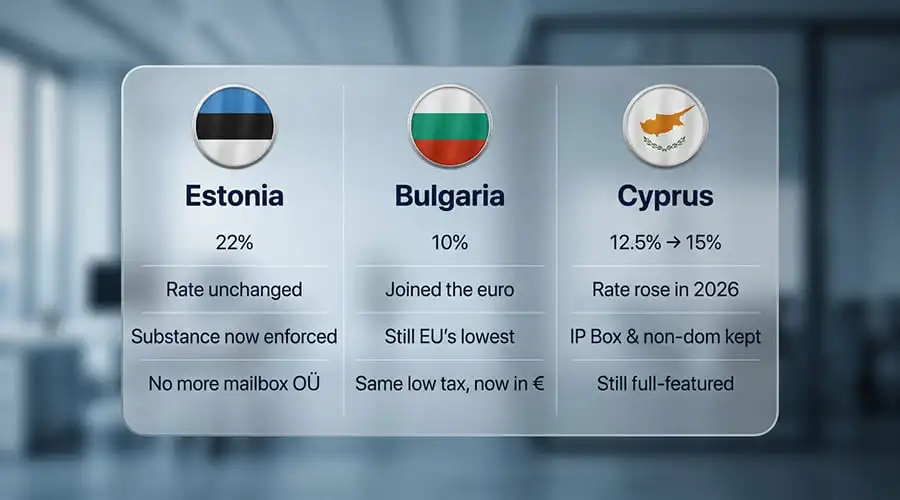
Bulgaria’s corporate income tax has held at a flat 10% since 2007 , the second-lowest headline rate in the European Union after Hungary (9%). Dividends paid out to individuals are subject to a separate 5% final withholding tax, so the true cost of extracting profit is higher than the headline 10% suggests — a point worth modelling before you assume Bulgaria automatically beats a higher-headline-rate jurisdiction on a full distribution basis.
2. Euro-Area Membership Removes Currency Risk
Bulgaria became the eurozone’s 21st member on 1 January 2026. For a company invoicing euro-area clients or paying euro-area suppliers, this removes lev-to-euro conversion from day-to-day accounting and treasury planning, and it makes direct cost comparisons with Cyprus, Estonia or other euro-area bases far more straightforward than they were a year ago.
3. Full Schengen Membership Simplifies Travel and Logistics
Bulgaria joined Schengen for air and sea borders in March 2024, and completed full membership when internal land border checks were lifted on 1 January 2025. A short transition period applied through the first half of 2025 for some road-border checks, but by 2027 that transition is fully behind Bulgaria. For founders and teams who travel frequently, or businesses coordinating road freight across the Balkans, this closes a gap that used to set Bulgaria apart from Schengen-only neighbours.
4. Fast, Low-Barrier Company Registration
A Bulgarian EOOD (single-owner limited liability company) can be registered with a minimum share capital of just €1, without a local partner, director or representative — a non-resident founder can own and manage 100% of the company directly. Registration with the Commercial Register typically takes a few business days once documents are in order, though timelines vary with registry workload and how quickly notarised documents and translations are prepared. This is a materially lower barrier to entry than jurisdictions that require paid-up minimum capital or a resident director.
5. Full EU Single-Market Access From a Cost-Efficient Base
Once registered and VAT-active, a Bulgarian company can sell goods and services across all 27 EU member states under the same single-market rules as a company based in any other member state — there is no second-tier access for having chosen a lower-cost jurisdiction. Combined with euro invoicing and comparatively low operating costs, this makes Bulgaria a genuine option for digital-services businesses and EU-facing e-commerce, not only for founders optimising purely for tax.
Who Bulgaria Is Not the Obvious Choice For
None of this makes Bulgaria the automatic answer for every founder. If your business is IP-heavy or structured around a holding company, jurisdictions with an IP Box regime and a non-dom framework — Cyprus company formation chief among them — still tend to outperform a pure low-headline-rate comparison once you account for how profit is actually extracted and structured. Bulgaria’s case is strongest for founders who distribute profit regularly, who need a low-friction EU base for trading or digital services, and who value Schengen and euro-area convenience as much as the tax rate itself.
FAQ
Is Bulgaria’s 10% corporate tax really the lowest in the EU?
Not quite: Hungary is lower at 9%. Bulgaria’s flat 10% is the second-lowest headline rate in the EU and has been unchanged since 2007. Dividends to individuals carry a separate 5% final withholding tax, which affects the total tax cost if you plan to distribute profit rather than reinvest it.
When did Bulgaria adopt the euro?
Bulgaria joined the eurozone on 1 January 2026 as its 21st member, replacing the Bulgarian lev.
Does Bulgaria have full Schengen membership?
Yes. Bulgaria joined Schengen for air and sea borders in March 2024, and completed full membership when land border checks were lifted on 1 January 2025, after a short transition period.
How much capital do I need to register a company in Bulgaria?
A Bulgarian EOOD can be registered with a minimum share capital of €1. Registration typically takes a few business days once your documents are ready, though exact timelines depend on the Commercial Register’s workload.
Can a foreigner own 100% of a Bulgarian company?
Yes. Non-resident founders can own and manage a Bulgarian company outright, without a local partner, director or representative.
Conclusion
Bulgaria’s pitch for 2027 is not a single headline number — it is the combination of a stable, decades-old 10% tax rate, euro-area membership, and full Schengen access arriving within the same short window. That combination genuinely changes the comparison for EU-facing distributors and digital-services founders. It is not automatically the right base for IP or holding structures, where jurisdictions built around that use case still tend to win. As with any jurisdiction choice, treat the figures above as a starting point rather than a final answer, and verify current rates and requirements before you file.
This article is for general information and does not constitute tax or legal advice. Rates and rules are current as of the publication date and may change; confirm figures relevant to your situation with a licensed advisor before acting.
Setting up a company abroad?
Get a free first consultation on jurisdiction, structure and banking.

This article is for general informational purposes only and is not legal, tax, or financial advice. Consult a qualified professional before acting. Editorial Policy.