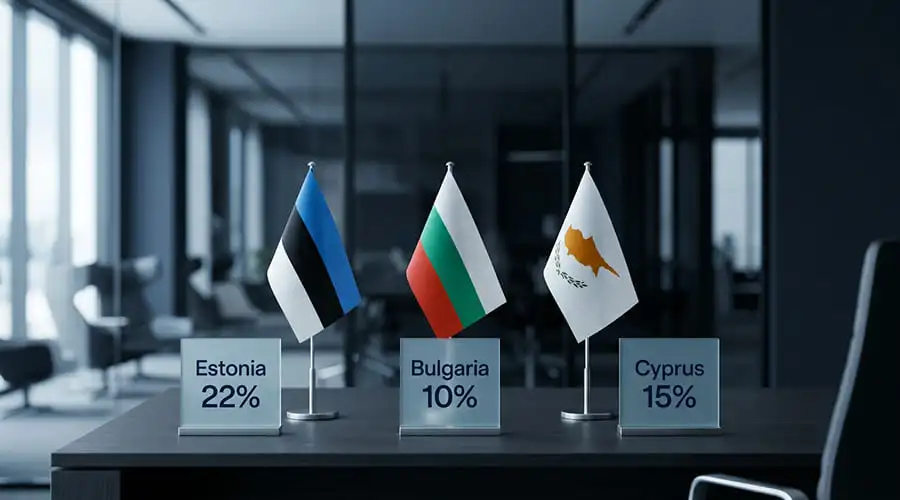
For years the mental shortcut for picking an EU jurisdiction stayed the same: Cyprus for the low rate, Estonia for the deferral, Bulgaria for the flat 10%. On 1 January 2026 several of those assumptions reset at once — Cyprus raised its corporate tax, Bulgaria joined the euro, and Estonia kept its rate but ended the era of the paper-only company. This is a clear, jurisdiction-by-jurisdiction rundown of exactly what moved and who is affected, so you can judge whether your current or planned structure still makes sense.
Cyprus Corporate Tax Rose from 12.5% to 15%
The headline change is Cyprus. As part of the most comprehensive tax reform in over twenty years, Cyprus raised its corporate income tax from 12.5% to 15%, effective 1 January 2026. The move aligns the island with the OECD global minimum standard and applies to all Cyprus companies, not just large groups.
The instinct to write Cyprus off over 2.5 points is understandable but premature. The same reform kept the features that made Cyprus attractive in the first place — the IP Box, the non-dom regime, the notional interest deduction and the participation exemption — so the rate change is one line in a much larger picture. Cyprus at 15% is still one of the EU’s lower headline rates.
Bulgaria Adopted the Euro at a Fixed Rate
On 1 January 2026 Bulgaria became the 21st member of the euro area, converting the lev to the euro at the irrevocable fixed rate of EUR 1 = BGN 1.95583, approved by the Council of the EU on 8 July 2025. For a Bulgarian company, invoicing, banking and pricing all shift to the single currency, removing conversion friction with EU counterparties.
Crucially, euro membership did not cost Bulgaria its main draw. The country retained its flat 10% corporate income tax — still the lowest headline rate in the EU — so the 2026 change is pure upgrade: the same low tax, now inside the eurozone with all the payment and credibility benefits that brings.
Estonia Kept 22% but Ended the “Mailbox Company” Era
Estonia’s tax model survived intact: 0% corporate tax on retained earnings, with 22% due only when profit is distributed. A planned rise to 24% was repealed in December 2025, so the distribution rate held at 22%. On paper, nothing changed. In practice, a lot did.
What shifted is enforcement. Estonian authorities now expect genuine substance, and pure “mailbox” OÜs are running into VAT-registration rejections and tougher bank compliance. The deferral model still works beautifully for a real business that reinvests — but the days of a paper company with no activity clearing every hurdle are over.
Pillar Two Clarity — Why Most Founders Are Unaffected
The change that generated the most anxiety is the one that touches ordinary founders least. The OECD’s 15% global minimum tax — implemented in the EU through the Minimum Taxation Directive — applies only to groups with consolidated revenue of at least EUR 750 million. A founder’s Bulgarian, Estonian or Cyprus company sits entirely outside that threshold and keeps its national headline rate.
So the correct reading of 2026 is not “the low-tax era is over.” It is that the map was redrawn: Cyprus a little higher but still full-featured, Bulgaria low and now in the euro, Estonia unchanged on rate but stricter on substance. The winners depend on what you actually do with your profit.
FAQ
Did Cyprus become expensive after the 2026 tax rise?
No. Cyprus raised its corporate rate from 12.5% to 15%, but kept its IP Box, non-dom regime, notional interest deduction and participation exemption. At 15% it remains one of the EU’s more competitive full-featured jurisdictions.
Does Bulgaria still have 10% corporate tax now that it uses the euro?
Yes. Joining the euro area on 1 January 2026 did not change Bulgaria’s flat 10% corporate income tax, which remains the lowest headline rate in the EU.
Did Estonia raise its corporate tax in 2026?
No. A planned increase to 24% was repealed in December 2025, so distributed profit is still taxed at 22% and retained earnings at 0%. What changed is stricter substance enforcement.
Does the 15% global minimum tax apply to my small company?
Almost certainly not. Pillar Two applies only to groups with consolidated revenue of at least EUR 750 million. Ordinary founder-owned companies keep their national rate.
Which EU jurisdiction is best after these changes?
It depends on whether you reinvest or distribute profit and how much substance you can support. The 2026 changes reshuffled the ranking rather than crowning a single winner.
Conclusion
1 January 2026 did not end the low-tax EU company — it rearranged the board. Cyprus is 2.5 points higher but kept every planning tool that mattered; Bulgaria pairs its unbeatable 10% with euro membership; Estonia’s deferral is intact but now demands real activity; and Pillar Two leaves ordinary founders untouched. The lesson is to re-test old assumptions against the new facts rather than default to last year’s shortcut. Map your structure to what actually changed, and you may find your jurisdiction is still right — or that a better one just opened up.
Not sure whether your EU company is still in the right jurisdiction after the 2026 changes? Send us your setup — where you are incorporated, whether you reinvest or distribute, and where you bank — on Telegram or WhatsApp, and we will pressure-test it against the new rules and flag anything worth restructuring.
Setting up a company abroad?
Get a free first consultation on jurisdiction, structure and banking.

This article is for general informational purposes only and is not legal, tax, or financial advice. Consult a qualified professional before acting. Editorial Policy.