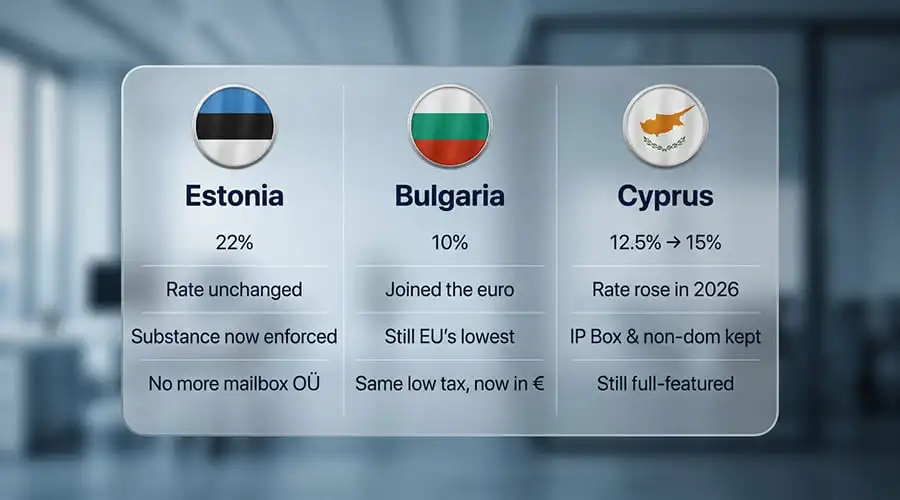
Ask a founder which EU company is cheapest and many will still answer “Cyprus” out of habit. After 1 January 2026 that reflex is wrong — or at least incomplete. Cyprus raised its rate, Bulgaria stayed rock-bottom and joined the euro, and Estonia’s real cost depends entirely on what you do with your profit. This is a straight comparison of the three most popular EU-company jurisdictions on headline rate, when tax is actually paid, and total cost of ownership — because the “cheapest” answer changes depending on whether you reinvest or distribute.
Headline Rates Side by Side
Start with the numbers, because they are where the myths live. Bulgaria charges a flat 10% corporate income tax , the second-lowest headline rate in the EU after Hungary (9%), unchanged since 2007. Cyprus now sits at 15%, up from 12.5% on 1 January 2026. Estonia’s headline looks highest at 22% — but that number is misleading, because of when it applies.
On a pure headline basis the ranking is simple: Bulgaria 10%, Cyprus 15%, Estonia 22%. If that were the whole story, Bulgaria would win outright. Also, check the countries which will save your money on registration on the EU in 2026. But a headline rate only tells you the price of a tax event, not when the event happens, and that timing is where Estonia rewrites the table.
When the Tax Is Actually Due — the Retained-Earnings Trap
Estonia’s 22% is charged only on distributed profit. Retained earnings are taxed at 0%. For a company that reinvests everything to grow, the effective rate is zero for as long as profit stays inside the business — no other EU jurisdiction matches that for a scaling startup.
Flip the scenario and the answer flips too. If you intend to pull profit out as dividends every year, Estonia’s 22% is charged on distribution and Bulgaria’s flat 10% suddenly looks far cheaper on the same cash. This is the retained-earnings trap in reverse: the “cheapest” jurisdiction depends less on the rate and more on your dividend policy. Reinvestors lean Estonia; distributors lean Bulgaria; Cyprus competes on features rather than the raw rate.
Beyond the Rate — Substance, Filing and Banking Costs
The headline rate is only part of the cost of ownership, and 2026 raised the non-tax side of the ledger. Estonia now enforces substance: pure mailbox OÜs face VAT-registration rejections and tougher bank checks, so a credible Estonian company needs real activity, which has a cost. Budget for genuine operations, not just an incorporation fee.
Cyprus carries the highest professional-services overhead of the three but buys the most planning machinery in return. Even after the reform it kept the IP Box (an effective rate around 3% on qualifying IP), the notional interest deduction and the participation exemption. Bulgaria is the simplest and cheapest to administer, and euro membership from 2026 removes currency friction on top.
Which Profile Suits Which Founder
Translate all of that into three founder profiles. The reinvesting startup that keeps profit inside the company to grow gets its best deal in Estonia, where retained earnings are untaxed — provided it can support real substance. The cash-distributing business that pays dividends regularly is usually cheapest in Bulgaria at a flat 10%, now with the added convenience of the euro.
The IP-heavy or holding company — licensing, royalties, cross-border dividends — often still lands on Cyprus despite the 15% rate, because the IP Box, participation exemption and non-dom regime do more for its effective rate than two points of headline tax cost it. As for the holdings, check this article. The point is that “cheapest” is not a single jurisdiction — it is a match between the rate structure and how you handle profit.
FAQ
Which EU country has the lowest corporate tax in 2026?
Hungary, at 9%. Bulgaria follows with a flat 10% headline rate, the second-lowest in the EU. Estonia is 0% on retained earnings but 22% on distributed profit, and Cyprus is 15%.
Is Estonia really cheaper than Bulgaria?
Only if you reinvest. Estonia taxes retained earnings at 0%, so a reinvesting company can defer tax indefinitely. If you distribute profit as dividends, Bulgaria’s flat 10% is usually cheaper.
Is Cyprus still worth it at 15%?
For IP-rich and holding structures, often yes. The 2026 reform kept the IP Box (~3% effective), notional interest deduction, participation exemption and non-dom regime, which can outweigh the higher headline rate.
Do I need real substance in these countries now?
In Estonia, increasingly yes — mailbox companies face VAT and banking rejections in 2026. Bulgaria and Cyprus also expect genuine activity, especially for banking.
Does euro membership make Bulgaria more attractive?
Yes. From 1 January 2026 Bulgaria uses the euro while keeping its 10% tax, removing currency conversion friction with EU clients and suppliers.
Conclusion
There is no single “cheapest EU company” in 2026 — there is a cheapest company for your profit policy. Reinvest and Estonia’s 0% on retained earnings is unbeatable; distribute and Bulgaria’s flat 10%, now in euros, wins on cash out; run IP or a holding and Cyprus at 15% still earns its place through features the others lack. The old habit of naming one winner is exactly what the 2026 changes broke. Decide how you handle profit first, and the jurisdiction follows.
Trying to work out which of the three is genuinely cheapest for your model? Send us your numbers — expected profit, whether you reinvest or distribute, and your substance capacity — on Telegram or WhatsApp, and we will run the comparison for your specific case rather than the generic headline.
Setting up a company abroad?
Get a free first consultation on jurisdiction, structure and banking.

This article is for general informational purposes only and is not legal, tax, or financial advice. Consult a qualified professional before acting. Editorial Policy.