On 1 January 2026 Bulgaria became the 21st member of the euro area, and the lev — a currency older than most of the people trading it — quietly became history. For the EU’s lowest-tax jurisdiction, this is bigger than a currency swap. It removes the last real objection to a Bulgarian company — exchange-rate risk — while keeping the 10% tax that made the country attractive in the first place. Here is what changed overnight, what founders had to update, and why Bulgaria just became a more serious option for cross-border businesses.
Changes on 1 January 2026
At the stroke of midnight on New Year’s Day, Bulgaria adopted the euro as its official currency and joined the euro area as its 21st member. The conversion was locked at the irrevocably fixed rate of 1.95583 BGN = 1 EUR — a rate Bulgaria had, in practice, been anchored to for years through its currency board, so the “shock” of conversion was more ceremonial than financial. Every lev balance, contract, and price simply became a euro amount at that fixed rate.
This was not a surprise sprung on the market. Bulgaria met the euro-convergence criteria and the changeover was scheduled and rehearsed, with the European Central Bank and the European Commission publishing the mechanics well in advance.
“Bulgaria adopted the euro on 1 January 2026, becoming the 21st member of the euro area, at the irrevocably fixed conversion rate of 1.95583 leva to the euro.” — European Central Bank, changeover statement, January 2026
What makes it interesting is not the mechanics — those went smoothly — but what a hard, shared currency does to the case for registering a company there.
What It Changes for a Bulgarian Company — No FX Risk, Customs in Euro
The most immediate change is the disappearance of currency risk. A Bulgarian company that earns in euro from EU clients and pays costs in euro no longer runs a lev exposure in the middle — no conversion spread, no hedging, no explaining the lev to a nervous counterparty. For a cross-border business, that is one whole category of friction gone.
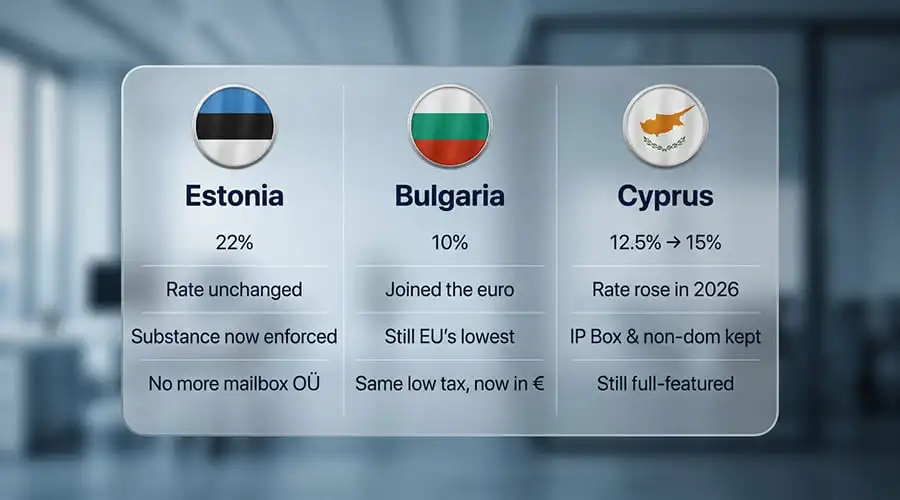
Invoicing and settlement are now in euro end to end. Just as importantly, customs values, duties, import VAT, and payments in Bulgaria are now expressed and settled directly in euro, removing the lev-to-euro conversion that used to sit on every import operation. A company importing goods through Bulgaria settles its customs and VAT obligations in the same currency it invoices and banks in. Meanwhile, the country keeps everything that made it attractive: 10% corporate income tax, 5% dividend withholding tax, €1 minimum share capital, and registration in one to three days. The tax map did not move; the currency map did.
What You Had to Update: Accounting Systems, Contracts, VAT, Dual-Pricing Transition
For existing Bulgarian companies, the euro was not a spectator event. Accounting systems had to switch base currency to the euro, with opening balances converted at the fixed rate and historical figures restated for comparability. Invoicing templates, price lists, and payment details all moved to euro. Contracts denominated in lev continued to be honoured, converted at 1.95583, but new agreements are written in euro from the start.
VAT compliance had to follow: thresholds, filings, and payments are now euro-denominated, and accounting software needed updating to file correctly. Bulgaria also ran a dual-pricing transition period, during which prices were displayed in both lev and euro so consumers and businesses could adjust — a standard eurozone-accession practice that smooths the psychological switch. For most companies the work was administrative rather than strategic, but skipping it risked mismatched books and rejected filings. The businesses that prepared in the last quarter of 2025 barely noticed the change; the ones that did not spent January catching up.
The Bigger Picture — 10% Tax Plus Euro Stability, and Who Benefits Most
Step back and the strategic picture is clean. Bulgaria has spent years as “the cheap EU jurisdiction with a small catch” — the catch being a national currency you had to manage. That catch is gone. What remains is the EU’s joint-lowest headline corporate rate at 10%, a 5% dividend tax, and now the euro. Cheap tax in a hard currency, inside the single market, is a combination the other low-tax options cannot all offer at once.
Who benefits most? Cross-border businesses that earn and spend in euro and want a low-tax base without currency management — e-commerce sellers, digital agencies, import-export operators, and holding structures routing euro dividends. For a founder who was weighing Bulgaria against a more expensive euro jurisdiction purely to avoid the lev, the reason to hesitate has evaporated. To sum up: Bulgaria did not get cheaper on 1 January 2026, but it got simpler — and for a company that lives in euro, simpler is worth real money.
FAQs
When did Bulgaria adopt the euro?
On 1 January 2026, becoming the 21st member of the euro area, at the irrevocably fixed conversion rate of 1.95583 BGN = 1 EUR.
Does joining the euro change Bulgaria’s low taxes?
No. Corporate income tax stays at 10% and dividend withholding tax at 5%. The euro changed the currency, not the tax regime — the reasons to choose Bulgaria for tax are unchanged.
What happens to contracts and balances that were in lev?
They convert to euro at the fixed rate of 1.95583 BGN = 1 EUR. Existing lev contracts remain valid and are simply honoured in their euro equivalent; new contracts are written in euro.
How does the euro affect importing through a Bulgarian company?
Customs values, duties, import VAT, and payments are now expressed and settled directly in euro, removing the lev-to-euro conversion step that used to apply to every import operation.
Is now a good time to register a Bulgarian company?
For a euro-based cross-border business, the case is stronger than it has ever been: the EU’s joint-lowest 10% corporate rate, a 5% dividend tax, €1 minimum capital, and now no currency risk. The main practical hurdle remains banking, which takes time regardless of jurisdiction.
Conclusion
Bulgaria’s euro adoption is the rare regulatory event that removes a problem without creating a new one. The lev is gone, currency risk with it, and the 10% tax that made Bulgaria worth considering stayed exactly where it was. For a cross-border company that earns and spends in euro, the last argument for choosing a pricier jurisdiction has just been retired. The country did not reinvent itself on 1 January 2026 — it simply lost its one awkward feature.
Thinking about a Bulgarian company now that the euro question is settled? Tell us how your business earns and spends and we will walk you through what setting up in post-euro Bulgaria actually involves — tax, VAT, banking, and timeline. Message us on Telegram or WhatsApp.
Setting up a company abroad?
Get a free first consultation on jurisdiction, structure and banking.

This article is for general informational purposes only and is not legal, tax, or financial advice. Consult a qualified professional before acting. Editorial Policy.