“When does my license need renewing?” used to be a simple question for operators licensed in Curaçao: a sub-license lasted as long as the master license behind it, and master licenses ran for five years. The National Ordinance on Games of Chance (LOK) changed that. Master licenses were not renewed, provisional licenses have been extended, definitive licenses are being issued, and the main recurring event is now an annual fee invoice rather than a renewal application. This guide sets out where renewals stand in late 2026 and what operators need to have in place for 2027.
From Master Licenses to Direct CGA Licenses
Under the old regime, four master licenses issued by the Ministry of Justice each supported hundreds of sub-licensees. When the reform began, the government chose not to renew them. They expired between August 2024 and January 2025, and sub-licenses lapsed with them. Only operators that held a direct license by 31 March 2024 moved into the new regime with a provisional license; sub-licensees with pending applications received a temporary certificate of operation while they waited.
The LOK entered into force on 24 December 2024 and the Curaçao Gaming Authority (CGA) took over supervision of online gaming in Curaçao. Provisional licenses issued on that date were extended by default to 24 December 2025. On 23 December 2025 the CGA confirmed that operators whose applications were still under review could keep operating under their provisional license until a decision. So in 2026, a license holder is in one of two positions: holding a definitive LOK license, or still operating under a provisional license pending final review.
Is There Still a Curaçao License Renewal Date?
According to the CGA’s portal guidance, a definitive LOK license is issued for an indefinite period, subject to suspension or revocation ‹verify with CGA — some older guides cite a five-year term›. In practice, that means “renewal” has been replaced by continuous supervision plus an annual payment. The license stays valid as long as you pay on time, keep meeting the substance and compliance conditions, and report changes to the CGA.
If you are still on a provisional license, the priority is to close any open requests from the CGA so that the definitive license can be granted. A provisional license is not a status to plan around for the long term.
The Annual Fee Cycle and the 15 January Deadline
Under the CGA’s fee guidance, annual fees are invoiced in advance and are due in full by 15 January each year. Current figures:
| License | Annual fee | Breakdown |
|---|---|---|
| B2C operator | €47,450 | €24,490 license fee (National Treasury) + €22,960 supervisory fee (CGA) |
| B2B supplier | €24,490 | Supervisory fee (CGA) |
In the first twelve months after approval, the CGA bills in two six-month installments: the first must be paid before the license is granted, and the second depends on eligibility to continue. After that first year, billing moves to the standard annual cycle. Missing the January payment puts your Curaçao license itself at risk, so build it into your cash-flow plan for the year. A full cost picture, including local staff and set-up, is in our article on Curaçao iGaming license cost and process.
What the CGA Checks on an Ongoing Basis
- Local substance: at least one managing director resident in Curaçao, and at least one full-time key person registered locally. From the fifth year after the LOK took effect, the requirement rises to three key persons ‹verify exact effective date›.
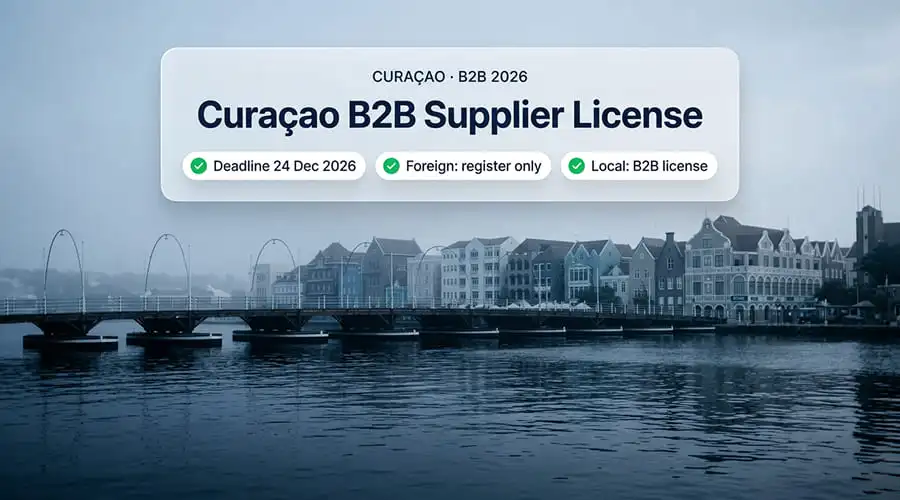
- Critical suppliers: from 24 December 2026, operators may only use critical suppliers registered with the CGA. Check your game studios, aggregators and platform providers now. Suppliers based on the island need their own Curaçao B2B license.
- AML/CFT and responsible gambling: policies, player verification and complaint handling to LOK standards.
- Changes in ownership or key persons: must be notified and approved; new UBOs and qualifying position holders carry additional fees.
- Domains and seals: each domain added to the license carries an administrative fee and must display the CGA’s validation seal.
Calendar: What to Do Before 15 January 2027
- Now: confirm whether you hold a definitive or provisional license, and close any outstanding CGA requests.
- October–November 2026: list every critical supplier and get evidence of CGA registration or licensing.
- By 24 December 2026: stop using any critical supplier that is not registered.
- December 2026: review substance (resident director, key persons) and update corporate records.
- By 15 January 2027: pay the annual CGA invoice in full.
For background on how the reform reshaped the market, see our overview of the LOK reform in 2026. If you need help with a pending application, a definitive license or switching from an old sub-license, start with our Curaçao gambling license service.
Frequently Asked Questions
Do Curaçao gaming licenses still need to be renewed?
Under the LOK, definitive licenses are issued for an indefinite period according to CGA guidance, so there is no fixed renewal application. The license remains valid subject to annual fees, ongoing compliance and the CGA’s power to suspend or revoke it.
Were the old master licenses renewed?
No. The four master licenses expired between August 2024 and January 2025 and were not renewed. Sub-licenses lapsed with them.
When are annual CGA fees due?
By 15 January each year. B2C licensees pay €47,450 and B2B licensees €24,490.
Can I still operate on a provisional license?
Yes, if your application is still under CGA review: in December 2025 the CGA allowed such operators to continue pending a final decision. You should still work to obtain the definitive license.
What changes on 24 December 2026?
The B2B transitional period ends. Licensees may then only obtain critical goods and services from suppliers registered with the CGA.
Sources: CGA fee guidance under the LOK (reported by AGBrief, October–November 2025); CGA decision on provisional licenses (Curaçao Chronicle, 27 December 2025); iGaming Business on the 31 March 2024 transition deadline; CGA announcement on B2B supplier compliance, 24 June 2026. Last updated: October 2026.
Disclaimer: This article is general information as of October 2026 and is not legal advice. License status depends on your individual CGA file; confirm deadlines, fees and requirements with the CGA and a qualified adviser.
Planning a gambling license?
Compare Anjouan, Curaçao, Tobique and Kahnawake with our licensing team. The first call is free.

This article is for general informational purposes only and is not legal, tax, or financial advice. Consult a qualified professional before acting. Editorial Policy.