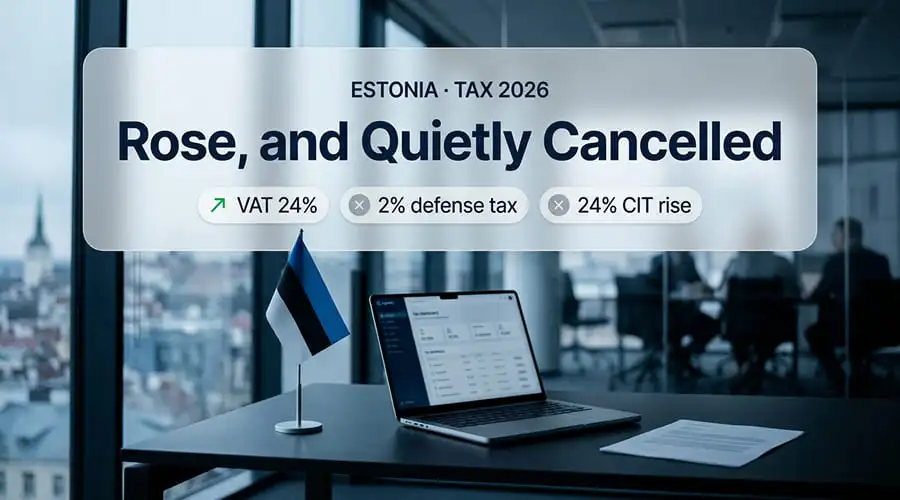
Estonia is still one of the fastest, most digital ways into the EU — you can form a company online, run it from anywhere, and defer tax on every euro you reinvest. But 2026 quietly changed the ground rules. The tax model is intact; the tolerance for paper-only companies is not. Before you pay the e-Residency fee, run through these six checks so your OÜ launches on solid ground and clears banking and VAT hurdles the first time, rather than stalling at the first compliance gate.
1. Confirm You Have a Genuine Business Model — Substance Now Matters
The single biggest change for 2026 is enforcement. Estonian authorities now expect real economic activity behind an OÜ, and pure “mailbox” companies are running into VAT-registration rejections and tougher bank compliance. A company that exists only on paper, with no genuine operations, is exactly the profile now being turned away.
Before anything else, be honest about whether you have a real business, the substance. Genuine clients, contracts, a plausible reason to be in Estonia, and some operational footprint are what turn an application from a red flag into a routine approval. If your only reason for the OÜ is a low tax number with no activity behind it, fix that before you file — not after a rejection.
2. Understand the Tax Model — 0% Retained, 22% on Distribution
Estonia’s headline 22% scares people who do not understand when it applies. Retained earnings are taxed at 0%; the 22% falls due only when profit is distributed as dividends. A planned rise to 24% was repealed in December 2025, so the distribution rate held at 22%. For a company that reinvests to grow, the effective rate is zero for as long as profit stays inside the business.
That makes Estonia superb for reinvestors and mediocre for founders who want cash out every year. Check your own dividend policy before you commit: if you plan to distribute profit annually, model the 22% and compare it honestly against a flat-rate jurisdiction. If you plan to reinvest, few EU structures beat the Estonian deferral.
3. Budget the Real Setup — e-Residency Fee and Timelines
Estonia’s process is fast, but know the real numbers so nothing surprises you. e-Residency costs a EUR 150 state fee (EUR 165 from 1 January 2027), with processing typically taking between two and eight weeks. Once you hold the digital ID, incorporating the OÜ itself is quick — commonly one to three business days.
Add the parts the headline fee leaves out. A legal address and contact person in Estonia, accounting, and the annual report are ongoing costs, not one-offs. None of it is expensive by EU standards, but budgeting for the full picture — not just the €150 — is what keeps the company compliant and in good standing after formation.
4. Plan for VAT and Banking Scrutiny
This is where under-prepared founders stumble in 2026. VAT registration is no longer a rubber stamp: a company that cannot demonstrate real activity can have its VAT application rejected, which is often a dealbreaker for a trading business. Prepare evidence of genuine operations — contracts, clients, invoices, a coherent business plan — before you apply.
Banking runs on the same logic. Whether you use an EU business bank or a fintech, expect real due diligence on the business and its beneficial owners, and expect more questions if the company looks like a shell. Line up your documentation early, be ready to explain the substance behind the company, and the account opening that trips up unprepared applicants becomes straightforward.
FAQ
Do I need real substance for an Estonian OÜ in 2026?
Increasingly, yes. Authorities now expect genuine activity, and mailbox companies face VAT-registration rejections and tougher bank checks. A company with real operations clears these hurdles far more easily.
How is an Estonian OÜ taxed?
0% corporate tax on retained earnings and 22% on distributed profit. A planned increase to 24% was repealed in December 2025, so the distribution rate remained 22%.
How much does e-Residency cost and how long does it take?
A EUR 150 state fee (EUR 165 from 1 January 2027), with processing usually between two and eight weeks. After that, incorporating the OÜ itself typically takes one to three business days.
Can I still run an Estonian company entirely from abroad?
Yes — the model is built for it — but “from abroad” is not the same as “with no activity.” You can manage the company remotely, provided it has genuine business substance behind it.
Is an Estonian OÜ still worth it after 2026?
For a real, reinvesting business wanting fast, digital EU access, yes. For a paper company seeking only a low rate with no operations, 2026 enforcement has made it a poor fit.
Conclusion
Estonia remains one of the smartest, fastest routes into the EU — but 2026 rewards the prepared and punishes the paper-only. The tax model is unchanged and excellent for reinvestors: 0% on retained earnings, 22% only on distribution, with the planned 24% rise scrapped. What changed is that substance, VAT and banking now demand real activity. Run these checks first — a genuine model, the right tax expectation, the full setup budget, and evidence ready for VAT and banking — and your OÜ launches cleanly instead of stalling at the first gate.
Planning an Estonian OÜ and want it to clear VAT and banking the first time? Send us your business model and where you will operate on Telegram or WhatsApp, and we will tell you what substance you need and set the company up to pass scrutiny from day one.
Setting up a company abroad?
Get a free first consultation on jurisdiction, structure and banking.

This article is for general informational purposes only and is not legal, tax, or financial advice. Consult a qualified professional before acting. Editorial Policy.