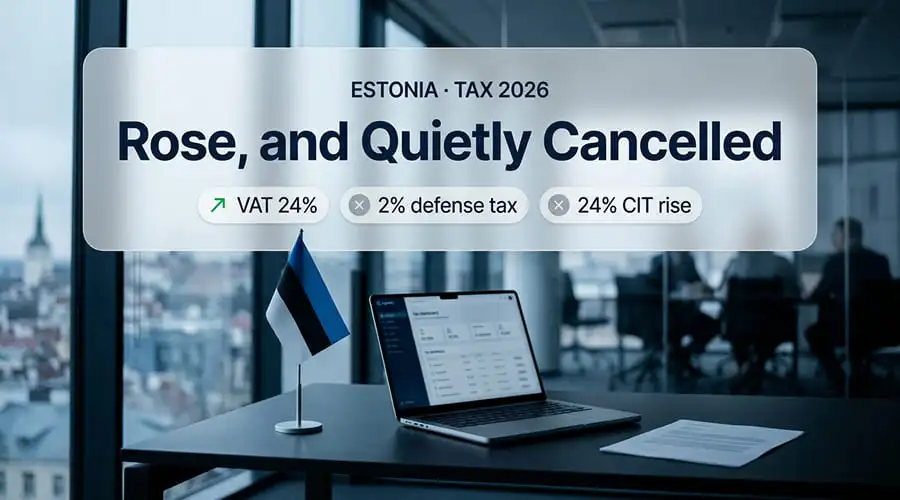
Estonia spent 2025 under a cloud. A distribution-tax hike to 24% was on the table, and e-Residency vetting was visibly tightening. Founders who had built their plans around the country’s famous 0%-on-retained model started asking whether the deal still held. Then Parliament cancelled the hike, the 22/78 model survived intact, and 2025 turned into a record year for new e-resident companies. So where does that leave a founder weighing an Estonian OÜ in 2026? Our view: still excellent for one profile, increasingly wrong for another. Here is the honest read.
What Changed: Hike Cancelled, Model Intact, Vetting Tighter
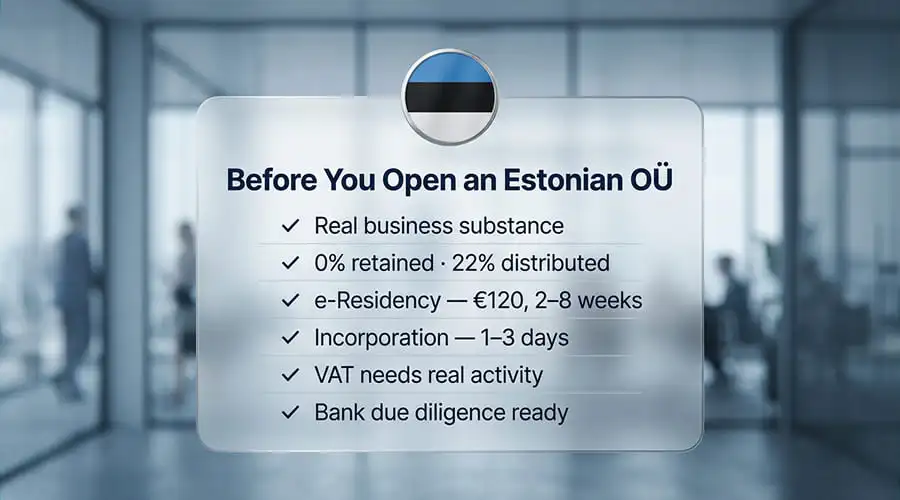
Start with the good news, because it is the headline. The planned rise of Estonia’s distribution tax to 24% was cancelled by Parliament in December 2025. Corporate income tax on distributed profit stays at 22/78, and retained earnings remain untaxed. The core promise that made Estonia famous — reinvest and pay nothing, distribute and pay a flat rate — is unchanged for 2026.
The record numbers confirm the model is working as intended. E-residents founded 5,556 new companies in 2025, up 15% year on year, and the programme delivered roughly €125 million in direct state revenue, an 87% annual rise. That is not a jurisdiction in retreat. Nevertheless, one thing genuinely did tighten: vetting. The Police and Border Guard Board now declines e-Residency applications where the business rationale is unclear or the activity code does not match the stated model. Estonia did not close its doors — it started reading the applications more carefully. The tax stayed generous; the gatekeeping got serious.
Who Estonia Still Fits Perfectly: Reinvestors and Remote, Digital Businesses
For the right founder, Estonia in 2026 is as good as it has ever been. The reinvestor is the clearest fit. If your plan is to grow the company by feeding profit back into it — hiring, product, acquisition — the 0% rate on retained earnings means the main tax event simply never arrives. A software company compounding revenue, an agency reinvesting margin, a holding vehicle accumulating capital: for each of these, Estonia’s deferral model is close to unbeatable in Europe.
The second natural fit is the genuinely remote, digital business. e-Residency was built for founders who run a real company from anywhere — consultants, SaaS builders, digital service providers with clients across borders and no need for a physical footprint in any one country. For this founder, incorporation is fast and fully remote, the euro is the currency, EU single-market access comes built in, and the administrative burden is light. The tightened vetting is not an obstacle for these businesses — it is a formality, because their business rationale is exactly what the vetting is looking for.
Who Should Think Twice — Founders Who Need Regular Dividends, and “Paper” Companies
Estonia is not for everyone, and pretending otherwise costs founders money. The first group who should think twice: anyone who needs to draw regular income from the company. The moment you distribute profit, you pay 22/78 — roughly 22% of the net amount you take out. For a founder living on dividends, Estonia offers no advantage over a straightforward low-rate jurisdiction, and Bulgaria’s combined ~14.5% on extracted profit will usually beat it. The deferral model only rewards you if you actually defer.
The second group: anyone hoping to run a “paper” company — a registered address with no real activity behind it. This is where the tightened vetting bites hardest, and it is not a temporary mood. The Police and Border Guard Board is now actively declining applications that read as substanceless, and at the EU level the substance principles of the withdrawn ATAD3 “Unshell” Directive are being folded into the Directive on Administrative Cooperation. A shell was never a good idea; in 2026 Estonia it is a rejected application at best and a compliance liability at worst.
The Substance Question — Why a Real Business Model Now Matters at Application Stage
The most important shift in Estonia is not the tax — that held — but when substance gets tested. It used to be that substance questions, if they came at all, came later: at the bank, at audit, during a tax review. Now the first test is at the application gate. The Police and Border Guard Board evaluates whether your stated business makes sense and whether your activity code matches it before you are ever incorporated.
This is a healthier system, not a hostile one. It means a founder with a real business and a coherent plan sails through, while a founder assembling a jurisdiction-shopping structure with no operational logic gets stopped early. For legitimate businesses, the practical takeaway is preparation: come to the application with a clear description of what the company does, an activity code that matches, and a plausible account of why Estonia fits the model. Meanwhile, the broader EU direction — ATAD3’s substance tests surviving inside the DAC framework — means this is not an Estonian quirk but the shape of things across the union. Substance is now an entry requirement, not an afterthought.
FAQ
Did Estonia’s corporate tax go up in 2026?
No. The planned rise of the distribution tax to 24% was cancelled by Parliament in December 2025. Distributed profit is still taxed at 22/78, and retained earnings remain untaxed.
Is e-Residency harder to get now?
More scrutinised, yes. The Police and Border Guard Board now declines applications where the business rationale is unclear or the activity code does not match the stated model. For a real business with a coherent plan, it is a formality; for a substanceless structure, it is a likely rejection.
Is Estonia a good choice if I want to pay myself dividends regularly?
Usually not the best. Every distribution is taxed at 22/78. If you need regular income rather than reinvestment, a jurisdiction like Bulgaria — roughly 14.5% combined on extracted profit — will often cost you less.
Was 2025 actually a good year for Estonian companies?
Yes. E-residents founded 5,556 new companies in 2025, up 15% year on year, and the programme generated around €125 million in direct state revenue, an 87% increase. The model is clearly still attracting founders.
Do I need real substance for an Estonian company in 2026?
Increasingly, yes — starting at the application stage. A real business model and a matching activity code now matter up front, and the EU is folding ATAD3’s substance principles into the DAC framework, so the pressure is structural, not temporary.
Conclusion
Estonia in 2026 is not the jurisdiction its 2025 anxiety suggested. The feared tax hike was cancelled, the 22/78 model held, and the programme is posting record numbers. What changed is the gate, not the deal: Estonia now checks that a real business stands behind the application. For the reinvestor and the genuinely remote, digital founder, it remains one of the best options in Europe. For the dividend-drawer and the paper-company builder, it was never the right fit, and 2026 made that clearer. The honest answer to “is Estonia still worth it” is: yes — for exactly the founders it was always built for.
Not sure Estonia fits your model? Check our comparison of Estonia, Cyprus, and Bulgaria to see if there’s a jurisdiction you look for.
Tell us how you earn, whether you reinvest or draw profit, and what the company actually does, and we will give you a straight answer — Estonia or not — with the reasoning behind it. Message us on Telegram or WhatsApp.
Setting up a company abroad?
Get a free first consultation on jurisdiction, structure and banking.

This article is for general informational purposes only and is not legal, tax, or financial advice. Consult a qualified professional before acting. Editorial Policy.