The advertised free-zone “package price” is rarely the real number. Between visas, mandatory audits, e-invoicing readiness, and the tax filings that now apply, founders routinely underestimate year-one spend by a wide margin. This list breaks down the eight cost lines that quietly inflate a UAE free-zone budget in 2026, with current AED figures and the new compliance deadlines that carry penalties if you miss them. Read it before you sign, not after.
The Headline Licence Fee — and What It Excludes
The number in the ad is the licence fee, and it is real — but it is the floor, not the ceiling. Free-zone first-year setup typically runs AED 18,000–34,000, and mainland setup runs AED 25,000–60,000, yet the lower figure usually covers little more than the trade licence and a registration slot. Name reservation, the establishment card, immigration registration, and share-capital documentation sit outside that headline, and each one carries its own charge.
Treat the advertised package as step one of eight. The costs below are not scams or upsells; they are structural parts of operating a licensed UAE entity that the marketing quietly leaves off the poster.
Visas, Establishment Cards, and Office/Flexi-Desk Minimums
The second forgotten line is people and premises. Each residence visa you sponsor carries government fees, medical testing, and Emirates ID costs, and your visa quota is tied to the office solution you choose. A flexi-desk keeps early overhead low but caps how many visas you can issue, so scaling the team often forces an upgrade to a larger package.
Even the leanest setup needs an establishment card to sponsor anyone at all, and that is a recurring cost, not a one-off. Meanwhile, the office minimum you pick at licensing quietly sets your ceiling for the year — choose too small and you pay again to expand, choose too large and you have burned cash on empty desks. Check these free zones and see which one fits your busuness plan the most.
The Compliance Costs New in 2026 — Audit, E-Invoicing, Corporate Tax Filing
This is where 2026 rewrites the budget. Corporate tax is now a live obligation, not a future one: the second corporate tax return, for the financial year ending 31 December 2025, is due on the EmaraTax portal by 30 September 2026, and missing it triggers penalties. Companies with revenue above AED 50 million must prepare IFRS-compliant audited financial statements, which means an auditor’s fee that never appeared in the licence package.
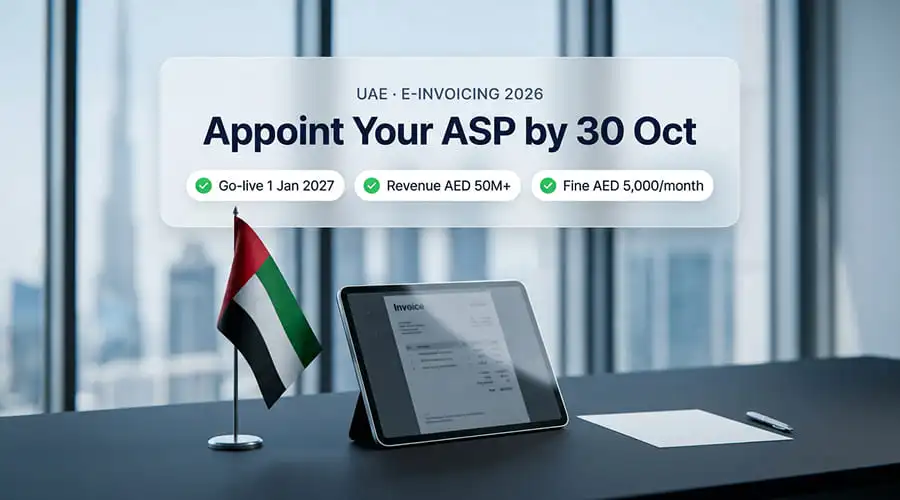
E-invoicing lands in the same window. E-invoicing for B2B and B2G transactions opened on a voluntary basis on 1 July 2026 and becomes mandatory from 1 January 2027 for businesses with revenue of AED 50 million or more (from 1 July 2027 for the rest), so your accounting system needs to be compliant before your deadline, not after your first rejected invoice. Between the audit, the filing, and the e-invoicing readiness, compliance has become a real annual cost line rather than an afterthought.
The QFZP Trap — How One Wrong Invoice Costs You the 0% Rate
The eighth cost is the one that does not show up as a fee at all — it shows up as tax you did not plan to pay. Free-zone companies keep the 0% corporate tax rate only as Qualifying Free Zone Persons, and only on qualifying income; everything else is taxed at 9% above AED 375,000. The catch is binary and unforgiving. Breach the de minimis threshold — non-qualifying revenue above 5% of total revenue or above AED 5 million, whichever is lower — and you forfeit the 0% rate for the current year and the four following years.
That is a five-year penalty triggered by a single mislabelled revenue stream. Nevertheless, founders routinely treat the 0% as automatic and only discover the conditions when an auditor flags them. Budgeting for a UAE free-zone company in 2026 means budgeting for the advice that keeps you inside the QFZP rules, because the cost of falling out of them dwarfs every line above.
FAQ
How much does a UAE free-zone company really cost in year one?
Free-zone first-year setup typically runs AED 18,000–34,000, but that covers mainly the licence. Visas, establishment card, office solution, audit, and tax-filing costs sit on top, so the real year-one figure is usually well above the advertised package.
Is free zone cheaper than mainland?
On the licence line, yes — free zone runs AED 18,000–34,000 against mainland’s AED 25,000–60,000. But market-access rights and total compliance cost can close that gap, so compare the full picture, not the headline.
Do free-zone companies pay corporate tax?
Only if they fall outside the qualifying rules. A Qualifying Free Zone Person keeps 0% on qualifying income; other income is taxed at 9% above AED 375,000.
What happens if I breach the QFZP de minimis threshold?
Non-qualifying revenue above 5% of total or above AED 5 million forfeits the 0% rate for the current year and the four following years — a five-year consequence from a single breach.
When are the 2026 compliance deadlines?
The corporate tax return for the year ending 31 December 2025 is due on EmaraTax by 30 September 2026, and B2B/B2G e-invoicing, voluntary since 1 July 2026, becomes mandatory from 1 January 2027 for businesses with revenue of AED 50 million or more (1 July 2027 for smaller businesses).
Conclusion
A UAE free-zone company is a strong vehicle, but the advertised package is the smallest number you will pay. The real budget adds visas and premises, the 2026 compliance layer of audit, e-invoicing and corporate tax filing, and the advisory cost of staying inside the QFZP rules. Price the full eight lines up front and the setup is predictable; price only the licence and the year-one bill will surprise you. The most expensive line of all is the 0% rate you lose by not planning for it.
Want a real year-one budget for your UAE free-zone plan rather than the poster price? Tell us your activity, headcount, and expected revenue on Telegram or WhatsApp, and we will cost out all eight lines — including whether you qualify for the 0% rate.
Setting up a company abroad?
Get a free first consultation on jurisdiction, structure and banking.

This article is for general informational purposes only and is not legal, tax, or financial advice. Consult a qualified professional before acting. Editorial Policy.